Researchers from Campus Leon and Campus Celaya-Salvatierra created an infrared device to ease the work in emergency or intensive therapy areas.
Celaya, Gto., August 31, 2016.- To save time in emergency clinical procedures, when the patients are in critical state and a blood analysis is necessary or to administer medication and serums, a team of researchers from the University of Guanajuato (UG) designed a device to efficiently localize the subcutaneous veins.
It is about Dr. Modesto Antonio Sosa Aquino and the student of the master degree in Physics, Angélica Hernández; as well as Dr. Nicolas Padilla, from Campus Celaya-Salvatierra.
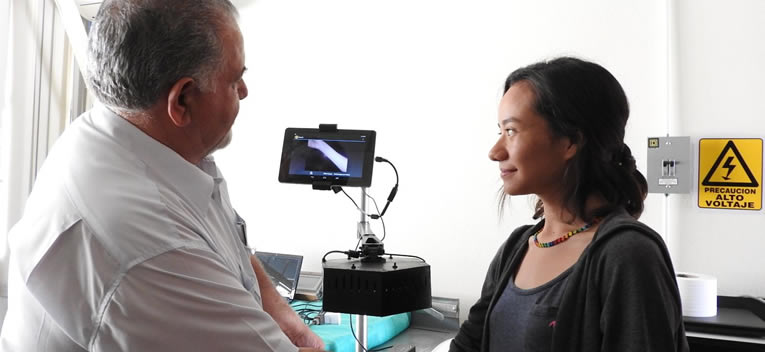
The device is based of infrared radiation, which sends the signal to a screen where you can easily see the blood conducts. A feature of this device is that it works with continuous electricity and is composed by a metal arm which can be used by the health personnel to easily find a vein.
"Most of the times in emergency situations or disease, the veins collapse and cannot be seen even with a tourniquet, this device eases the localization of the vein trajectory and theoretically eases the puncture making less damage to the patient," commented Dr. Nicolas Padilla Raygoza, who is responsible for the validity and reliability project of the device.
The prototype is a metal bases that is capable of adhering by pressure on a fix platform, has two metallic arms, one that holds an infrared camera that sends the signal to the other arm, which holds a screen where you can neatly see the patient's arm with the vein to puncture.
There is similar technology in the market, but the price is steep and is not available for the public sector.
"We are going to try the device in a six-month period, at the end we'll know if it has the validity and reliability from the health professionals, if it manages to ease their work at the time of making vein puncturing, an industrial secret protection will be requested so it can be fabricated and commercialized," concluded Dr. Padilla.