
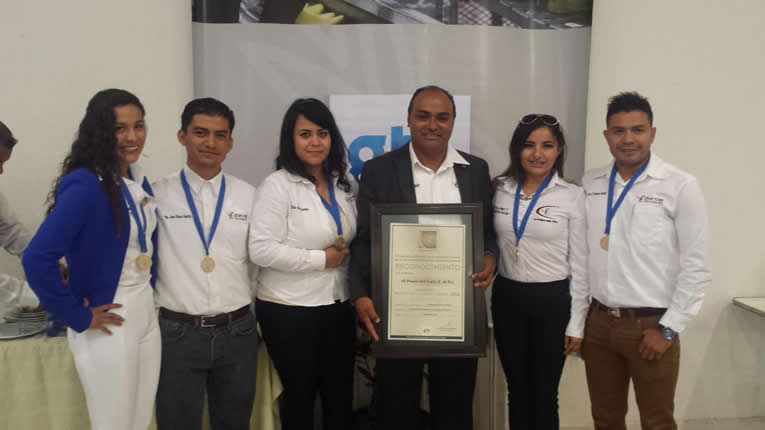
 Salamanca, Gto. September 7, 2016.- A college company of green energy, is placed among the ten finalists of the national contests Cleantech Challenge Mexico and the Banamex Award to the business with greater social impact.
It is about 4E Power and Fuels, an industrial facility that processes solid, humid and dry organic residue, using 0-emmissions technologies and advanced engineering of processes to obtain diverse products such as solid biofuels, biogas, bio fertilizers and thermic and electric energy.
That is what Dr. Alejandro Zaleta Aguilar, professor and researcher of the Division of Engineering of Campus Irapuato-Salamanca of the University of Guanajuato, and leader of the project where 20 students participated mentioned. Before founding 4E Power and Fuels, the professor was the Coordinator of Liaison at UG, he was director of Guanajuato Techno Park (GTP) and has led 70 innovative projects in alternate energies.
It is important to mention that the 7th Cleantech Innovation Challenge received 1,279 proposals, which went through several stages, until only 10 finalists were left from different states in the country, The Banamex award to the company with greater social impact, at the same time, admits companies participating in the 4th phase of the Cleantech Challenge Mexico, that prove a measurable impact in society and the environment. It will be on September 28th in Mexico City when the winners will be revealed.
The college company founded on April 8 2011 is 100% Mexican, it offers innovation, quality, technological and scientific development for generating and obtaining energetics parting from renewable energy sources.
The product is a design of an industrial energy plant called "4E/SOLAR BIOGAS/RECOVERY/POWER PLANT" that consists in a system integrated by 8 sub processes (crushing, homogenizing, solar thermal hydrolysis, bio digester, solar concentrator, thermal drying, pelletizing, electric self-generation). It treats from 2 to 50 tons per day, or according the required model of organic solid residue.
With the implementation of the pilot, 2 tons' x day version, has managed to decrease 655 annual tons of (GEI) greenhouse effect gases, a weekly production of 120 m3 of biogas, 500 kg of pellets for bio combustion, 1,500 kg of dehydrated product and 650 kg of bio fertilizers. The energetic capacity is 112 kW (95 thermal kW and 17 electrical kW).