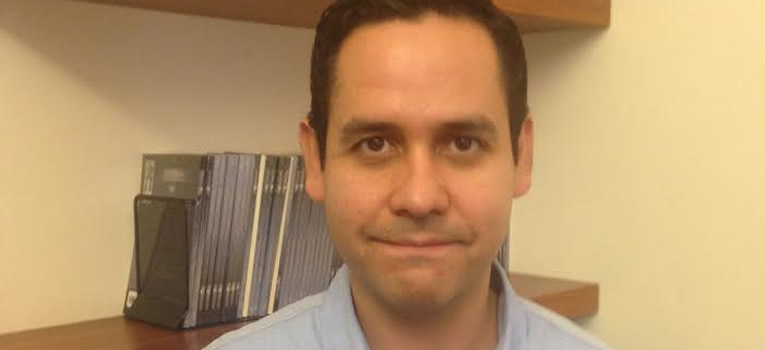
Guanajuato, Gto., Septmber 9, 2016.- The professor and researcher at the University of Guanajuato (UG), Dr. Carlos Vázquez Ferrel, was awarded with the Prize of the National Institute of Public Administration (INAP) 2016, for his work "The Legislative influence of the opposition in the presidential initiatives: the case of the minority governments in Mexico 1997-2012."
This research emerges with the objective to inquire and know the motivations of the legislators and party leaderships at the Congress, as well as finding out why they act like they do.
As a result, from this research, the professor and researcher at the Department of Political Studies and Government, found that the legislators act very rational with the purpose to achieve their objectives, in addition of being very sensitive to their context and react to any modification in the status quo.
Likewise, he realized that the parties in the Congress, far from being led in a dictatorship within, they open different margins of maneuver to some of the members, which influences so little by little the decision to collaborate with the executive power constitutes.
He highlighted that, if they start from a diagnosis –as precise as possible—on this important institution, this will allow to make reform proposals with greater possibilities of success to achieve a better representative organ, of legislative production and control of the government.
He mentions that the University of Guanajuato carries out activities focused on the subject, an example, is the First World Congress of Administrative Law which was held recently, to which attended specialists from other universities throughout the country and allowed the dialogue, divulgation and even the community in the topic.
It is important to mention, that this prize is granted as an annual public recognition to a relevant work, made with the purpose to improve the processes in the Federal Public Management, in benefit of society.
Today, Dr. Vázquez Ferrel is found making a postdoctoral stay at the School of Government and Public Transformation of the Tecnológico de Monterrey, on the analysis of the recently created anticorruption system in Mexico, a subject that affirms, has a lot to walk in the country.