Guanajuato, Gto., October 1, 2016.- In 1732, Mrs. Josefa Teresa de Busto y Moya donated her house to found the Hospice of the Holy Trinity, first background of what today is the University of Guanajuato, an institution that "was born for the love of the un-inherited" and that has maintained that spirit throughout 284 years of history.
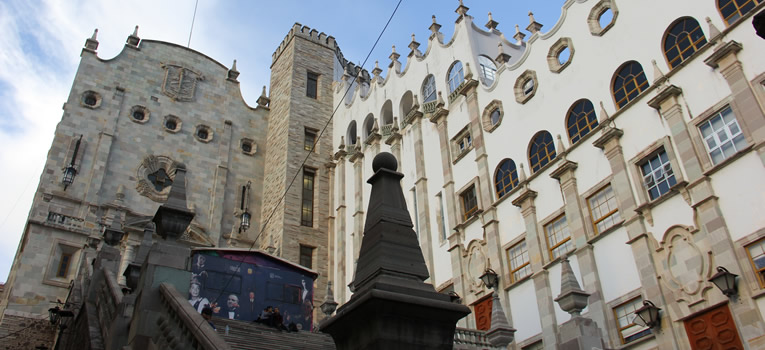
On October 1st, 1732, with help from prominent members of the society in Guanajuato, such as Don Pedro Lascuráin de Retana, emerged the greatest educational project of the state, that since then had as venue, besides the old house of Mrs. Josefa, the ancient chapel of the Otomíes, in what today is the patio of studies of the emblematic Central Building.
Years later, in 1744, the Spanish crown placed the education in the hands of the Jesuit priests which was taught in the College, but due to the expelling of this religious, the doors of the House of Studies remained closed for 18 years, until the reopening was achieved, now with the name of Royal College of the Purísima Concepción.
Despite the adverse circumstances the responsible for the institution faces, the educational project was on float, growing and in constant evolution. Figures such as Rev. Marcelino Mangas, Rector for almost 20 years and who had to face the independent fight and other armed conflicts, embodied with their example the values and university values: wisdom, respect, patriotism, humbleness and education.
Almost a century after the growth of the Legendary Hive, in 1827, the State committed to finance higher education, and granted resources for the foundation of a public library, a chemistry laboratory and a collection of minerology.
The institution grew strong, and despite the political sway, kept the path and a firm commitment with the education, that went from being secular and turned the institution in the State College, where they taught law and mining, but also arts and grammar.
In 1945, the State College transformed in University of Guanajuato, led by Don Armando Olivares Carrillo, strengthened its humanistic calling, as well as the concept of social responsibility that until today distinguishes the institution.
In this new stage, UG became in a referent in the area of culture, but also besides creating the Symphonic Orchestra of the University of Guanajuato, the Movie Club and Radio University, gave origin to the International Cervantine Festival, that began with the representation of the Entremeses de Cervantes.
A fundamental step in the institutional life was given in 1994, when the University stopped being under the guardianship of the state and achieved autonomy. Once it had the legal faculty to rule itself, UG began with a process of structural reorganization, but kept the principles and social mission.
In 2009, the university community was immersed in a profound change, by adopting a multi-campus structure and the departmental model, current today.
Always in constant evolution, the House of Studies currently lives in a process of review of its Organic Law, the Plan of Institutional Development (2010-2020) and a normative reform oriented to consolidate UG as a referent of academic quality and profound social commitment.