
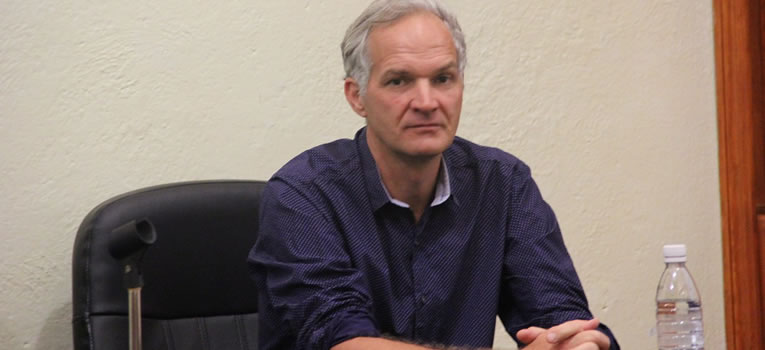
Guanajuato, Gto., October 7, 2016.- To reach the ideal in bio architecture, low cost and low environmental impact technologies must be developed and applied. These must be adequate for the community, and that also generate the sustainable transformation of the environment where they live, as assured by the Director of the Institute of Intuitive Technology of Bio Architecture (TIBA), Peter Van Lengen.
In the master conference "Edifications in harmony with their ecosystem" offered by the University of Guanajuato (UG), began their exposition listing the diverse factors and problems that affect the environment, which are defined evident, since they are seen every day, in addition, he invited the attendees to watch and learn from nature, as well as knowing the ecosystems, since they're a guide on how to make sustainable edifications.
He defined architecture as an art, a creative process, which must be based on the numerology, geometry, natural light and colors. He said that an important and fundamental resource for constructing places that don't have an environmental impact is the use of green roofs, meaning it is an edification covered with vegetation.
He highlighted that an important resource for bio architecture is the use of adobe for constructing, a technology that never modernized because since its origin ius perfect, besides being an ideal material for thermal investment, acoustic conditioning and high durability.
Van Lengen pointed out that it is important that besides having a low environmental impact, the architecture must have a cultural identity, that has features of the place where it is constructed.
Peter Van Lengen is an outstanding figure of Brazilian bio architecture, piooner in ecological sanitation; has led architects and agro-ecologists teams in diverse projects with communities, focusing in the restoration of natural resources and construction of sustainable edifications; in addition, he has participated in congresses and festivals with universities from Brazil, Mexico, Mozambique, South Africa, Portugal, Colombia, Spain, among other countries.
The conference was organized by UG through their program of Environmental Handling and Sustainability in collaboration with the Department of Architecture and House Naomin.