
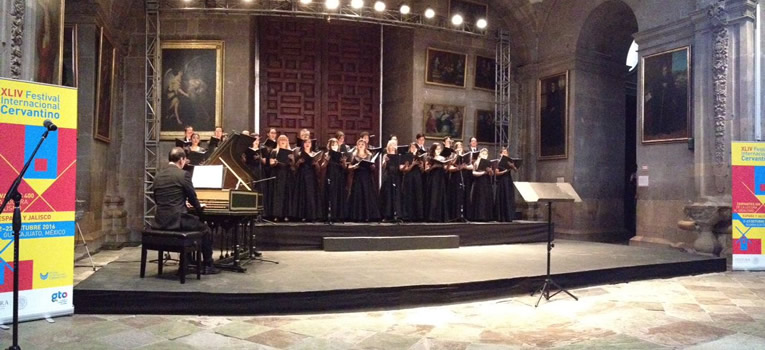
 Guanajuato, Gto., October 13, 2016.- The Choir of the University of Guanajuato (UG) embezzled its participation in the International Cervantine Festival (FIC) with a musical rehearsal on the influence and relevance of the language of the Song book of the Palace in the work of Miguel de Cervantes Saavedra.
The opportunity to commemorate 400 years of the death of the founder of the Spanish literature was the great reason for the attendants to the Company's Temple to enjoy and reflect towards Spanish music that probably heard and where the writer nurtured from to write plays such as Don Quijote de la Mancha.
The stage of "Who brought thee, knight...?" was in charge of the Director José Francisco Martínez Rodríguez, who besides directing and accompany the choir with the harpsichord, commented the presented pieces, many of which were about the work of Juan de Encina, poet, musician and dramaturge, of renaissance tradition and some medieval highlights.
With works such as "Oy comamos y bebamos," "Ay trsite que vengo", "Todos los bienes del mundo" and "Who brought thee, knight?" was showed the constant way the themed parallelism with the thought and expression of the great Cervantes, referring to topics such as death, fleetingness of life and pleasure of the moment.
Other pieces the Choir interpreted were "For some harbors up", of Antonio Ribera, "Lágrimas de mi Consuelo", of Antonio Cebrián and "Mi mal por bien es tenido" of Garci Sánchez de Badajoz. All these pieces of great poetic and lyric force that, according the Choir's Director, influenced the vision and language of Cervantes, who more than a prose writer, was a poet.
With this presentation, the Choir summed to two ensembles that interpreted thw work and figure of Miguel de Cervantes Saavedra, to know, La Grande Chapelle, of Spain, that presented the Requiem for Cervantes of Mateo Romero; and Organum Ensemble, of France, with "La encarnación del verbo."
So, UG's Choir achieves its third consecutive participation in the FIC, being this time the only Mexican group who presented in the ancient music programme.
It was a notable participation, because providing an interesting reading to the choral tradition of what the heir is in the city, set on stage great values of the Hispanic poetry.