
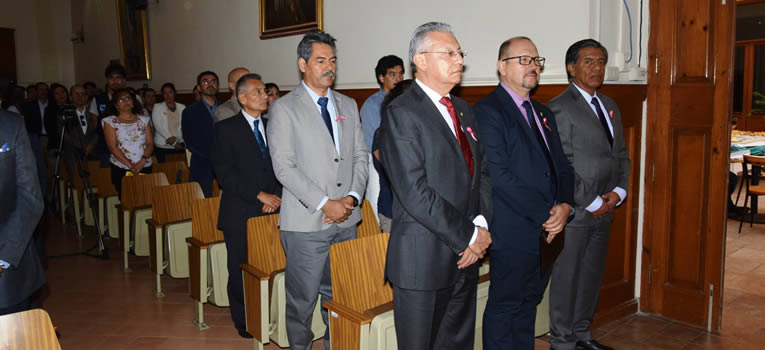
 Guanajuato, Gto., October 18, 2016. University authorities presented to the community members the "Insignia Program," which begins with two large scientific impact projects: Quantum cryptography for cybernetic protection and the construction of the Linear Accelerator of Particles (LINAC), which would be the first of its kind in Mexico.
"Insignia Program" seeks to maximize the impact of research in the House of Studies with a comprehensive, multidisciplinary focus and with an impact on society, by answering the actual demands.
At the project presentations, UG's Pro Vost, Dr. Héctor Efraín Rodríguez de la Rosa, representing the General Rector, Dr. Luis Felipe Guerrero Agripino, sustained that the "Insignia Program" represents an opportunity to show the leadership of UG researchers at a national level.
One of the projects is "Distribution system of quantum keys," led by Dr. José Luis Lucio Martínez, Coordinator of Insignia projects. With it, they seek to guarantee to send information through internet, which is completely vulnerable with quantum computers, which will become common on the next years.
The development of a quantum cryptography system, whose final objective is to protect information, involves researchers at the Industrial Development and Research Center (CIDESI) and the Research Center and Advanced Studies of the National Polytechnic Institute (CINVESTAV) unit Queretaro, as well as professors and students of the University of Guanajuato.
Regarding the construction of the Linear Accelerator of Particles, Dr. Mauro Napsuciale Mendívil, project leader and director of Support for research and Postgraduate at UG, explained that it is about a prototype with an energy of 5 Electronvolts (MeV) which will have applications in the health sector (sterilization of medical material, pasteurization of milk and water), analysis of leather in the leather-shoe sector and generation of synchrotron light to develop research in a wide variety of disciplines.
For the construction of this model, UG's postgraduate researchers and students, have trained in the National Laboratory Thomas Jefferson, at the University of Texas and in the School of Accelerators of United States, since in Mexico there are no scientists specialized in it.
Hence, at the same time of the impact in the development of scientific research, the construction of the LINAC will allow the formation of human resources and will tighten links with the international scientific community.
While announcing the "Insginia Program," Dr. José Luis Lucio highlighted that the projects will be carried out using the human resources and materials the University has, the collaborators will be commissioned professionals and will have the possibility to make direct negotiations to obtain external financing.
In addition, there will be an external evaluation committee, since every two years there will be a review of the progress and results to determine the continuity of the support for the projects.