
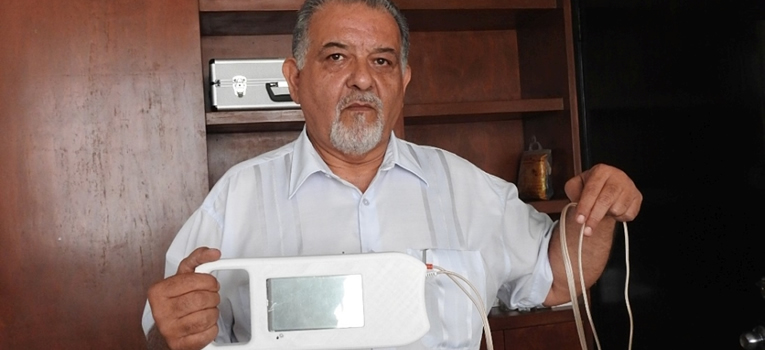
Celaya, Gto. October 28, 2016.- Doctor Nicolás Padilla Raygoza, professor of the Division of Health Sciences and Engineering, next to Dr. Teodoro Córdova Fraga & Dr. Modesto Antonio Sosa Aquino from the Department of Medical Physics and Biomedical Instrumentation of Campus León; and the student from the Master degree in Physics, Angelica Hernández developed, in 2011, a non-invasive device that detects in the babies the minor damages in the hip, preventing sequels in the development of the infant. The device was called "osseous radar" a hip luxation in newborns diagnosis system, through a sound effect.
After five years, the patent of invention was given to the University of Guanajuato. This was requested for an extension of 20 years and from now on, they have 15 years to transfer the device to the final user; in this case, the pediatrician who uses it with the patients.
Analyzing the first patent, the researchers could see the growth possibilities and for that reason in a second update, they developed the "Electroacoustic probe" which, although derives from the osseous radar, it has numerous changes both in aesthetics and operativity, since it now possesses a touch screen, the data it shows are decibels, it is much more sensitive and can connect directly to the electrical power.
With these updates, the electroacoustic probe, due to its sensitivity, it is pretended to be used to tests newborns and children with whom they expect a high validity and reliability and they already see it can be implemented for different osseous disorders such as osteoporosis and fractures, in the meantime, they are in negotiation with the medical local services as a research project.
Hip luxation, best known as dysplasia, is a disease in the development of the hip, and it is because a malformation and articulation of the hip.
It is called a full luxation when the head of the femur and thigh bone are out of place, for example, dysplasia is as simple as the cavity to be inclined and not curve or the femur head is not fully developed, which eases the dislocation and cause further complications.
Dr. Nicolás Padilla explains that this illness presents only in the 1% of the newborn and only 1 of 7,000 new born alive present it in the world, although he added that it depends on the ethne, since the Eskimos have a high index of hip luxation because of the accessories to move the children; since they are wooden, tight and make their legs close easing the luxation. But for the Indian Americans, Mexican and Latin American, they carry their babies with their legs open which makes hip luxation almost null.
However, far from the ethnic attributes, this illness can present from the fetus formation, because the baby could come in a sitting position or when they hold the baby by the heels without any back support, since their frail hop "bends" and may luxate; the correct way to hold the baby, explains Dr. Padilla, "is to take him by the heels and the back" and he adds, another form that may cause dysplasia is tuck him very tight with the legs extended or closed.
Other practices that favor this illness is the use of baby-walkers and, he warns, when you carry the baby sitting in the arm, it always has to be in an upright position, because, if the arm inclines the baby's his misaligned and can be a unchaining factor. Hence, in the pediatrician consult, it is important to monitor with the osseous radar to timely diagnose hip alterations.