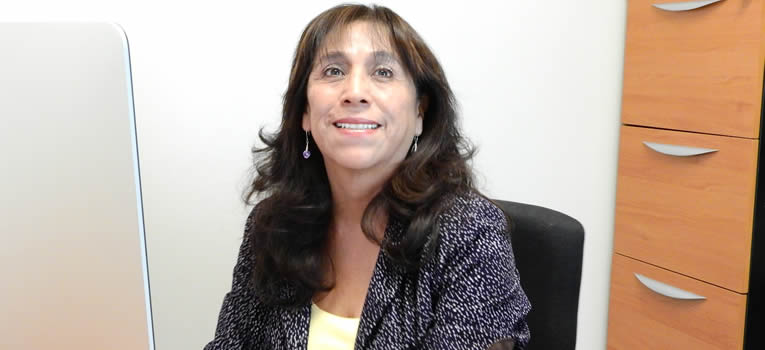
 Celaya, Gto. November 1, 2016.- The concept of environment and sustainable development refers to the efficient and rational administration of the natural resources, in such form that it is possible to improve the wellbeing of the current population without compromising the quality of life in the future generations and the sustainability in environment is an unpostponable matter to assume, explains Dr. Gloria Miranda Zambrano, specialist in topics of sustainability, social ecology, sustainable tourism, identity, culture and traditional medicine, who is a professor at the Division of Social and Administrative Sciences at Campus Celaya-Salvatierra at the University of Guanajuato.
Dr. Zambrano, is part of the academic body "business strategies, competitiveness and sustainability", has several publications among which stands out "contributions of the rural communities to sustainability: Ejidal Parl San Nicolás Totolapan, México"; in the same fashion, she writes for different scientific magazines and is member of the National Researchers System of CONACyT.
She explains, as a researcher, she has the commitment to research alternative paradigms to recover nature, life, territory and humanity", she currently works in a project titled "recovery of the biodiversity between Mexico and Peru" and adds "both countries have a similar biological and cultural reality, hence, she wants to rescue the knowledge through indigenous communities to revalue them, recover species and empower them in their production." For that, she works in her search, with support from the Peruvian University of Los Andes, at the Andes Mountains.
"The main objective is to rescue and promote the populations and increase actions before the problem of exclusion; in this project, I will incorporate new ways to see the field and will make an analysis between the region of the Bajio with the community of Ojo de Agua of Ballesteros, located in the city of Salvatierra, in contrast with the culture and Peruvian orography, manifesting that the word "poor" undermines the community and its people, who have great knowledge."
"Once they realize what they are capable of, what they know emerges and their work expedites the work's rhythm of the community", she adds.
Dr. Zambrano has worked over four years with the community of Ballesteros, where she explains, the work the populators do once they understand their capabilities, allows them to be someone else, more reflective of their roots, of their role in society and understand that they must exploit earth in a better way, she points out.
Not too long ago, she had the opportunity to participate in the 3rd International Congress of Sustainability and Climate Change where she presented a progress of her work and used the opportunity to offer a conference on "Indigenous sustainability and tourism; utopia or reality?" where she shared credits with Dr. Eva Conraud Koellner, professor at the Division of Economic-Administrative Sciences of the University of Guanajuato and specialist in marketing.