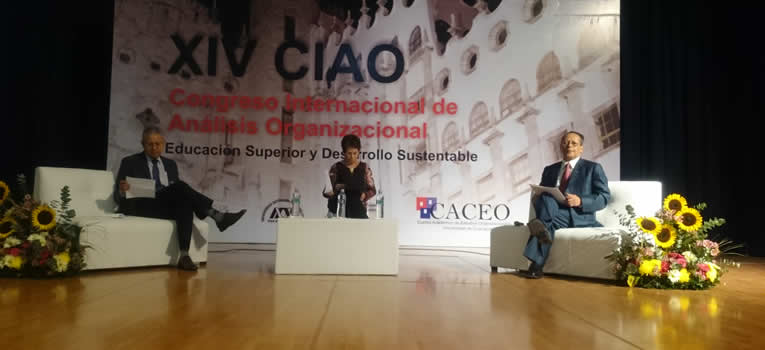
 Guanajuato, Gto., November 10, 2016.- Topics such as permanence or disappearance of the universities, budget cuts, strategic role of education in the economic growth, mobility, link with the productive sector, were analyzed in the panel "Problems and emergent topics of Organizational Analysis. Higher Education and Sustainable Development."
The panel led by Dr. Silvia Álvarez Bruneliere, ex-Rector of the University of Guanajuato (UG), occurred at UG's General Auditorium where the same Dr. Raúl Arias Lovillo, Academic Secretary at UG, and Dr. José Octavio Nateras Domínguez, Rector of the Universidad Autónoma Metropolitana unit Ixtapalapa.
In the impact topic that budget cuts to higher education, Dr. Nateras recognized that naturally, in the national context, the economic resources are one of the problems that must not be overseen, since a large quantity of young students don't have the possibility to access higher education and this impacts directly in unemployment, violence and lack of opportunities. If there is no sufficient budget, there must be always negotiations from federal instances, because the situation is dramatically bad.
In his opportunity, Dr. Arias Lovillo developed the topic of the strategic roles of higher education in the future economic growth of the country, from where he reminded that the economy in the 70s was conceived as a country that could prosper if it had oil or other productive factor, but the world has changed and today we live in another stage, so the universities have the great challenge to generate new knowledge for society.
He pointed out that the index of human development is another factor to consider, and recognized that there has been a lack of vision in the governments for a greater support to higher education institutions; it is not an academic problem, he said, but to re-think the strategic role of the university to create new knowledge not only allows to solve ancient problems but the one that come.
Afterwards, Dr. Nateras spoke about strategies to achieve a more efficient link with the productive sector and Dr. Arias on the "leak of brains", internationalization and mobility, on where he observed that globalization has been a fundamental strategy of many countries, thanks to this, many students from United States and Europe have been benefited with mobility, but not Latin Americans who don't have much experience.
In the opinion of Dr. Arias, this mobility must not be elitist and favor a small group of college students, but must bring the internationalization processes "home, we can make many interuniversity works parting from there" and the formation of the degree and postgraduate students, have that experience, even with seminars with first level professors to any country of Latin America, to encourage the processes of liaison.
Our students must form with a global mindset, capabilities and skills that allow them to develop an internationalization, which has a very important role for the universities, he sustained.
Finally, both panelists disserted on if colleges will disappear in 10-year term, as some studies say. Dr. Nateras estimated that, in his function and role of forming people in diverse areas of knowledge, they'll continue to exist.
In that tone, Dr. Arias revealed that in Mexico there are 3,400 private universities, "it even is offensive", he said, since there are "want-to-be universities" that open their garages, and declared himself defender of the public university, "not an enemy of the private university", but with quality.
UG's Academic Secretary, defended the idea that "large universities, the important ones", will not disappear because there is a great social responsibility, and the greater defense of higher education institutions, must be the social commitment, he concluded.