
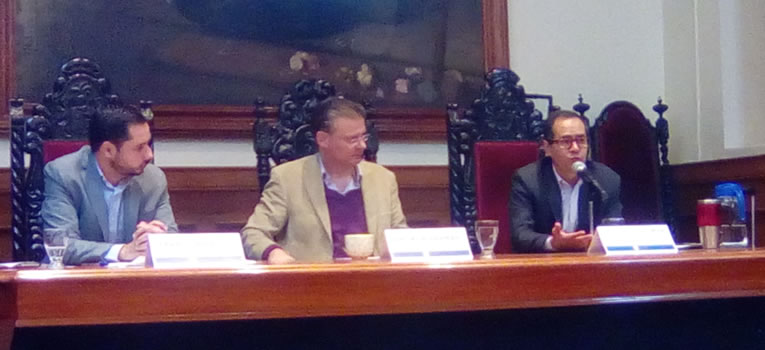
Guanajuato, Gto., December 3, 2016.- "En busca del Sr. Jenkins. Dinero, Poder y Gringofobia en México" (In search of Mr. Jenkins. Money, Power and Gringo-phobia in Mexico) from the English journalist Andrew Paxman, is a history book yes, but also a delightful insight of the political and economic policies of the 50s and 60s in Mexico, when William Oscar Jenkins was the most hated North American by the Mexicans.
So, that was manifested during the presentation of the quoted text in Hall of Acts of the Division of Law, Politics and Government (DDPG), summoned by the academic bodies of the master in History and Historical Studies and Democracy, Civil Society and Freedoms; of the Departments of History and Political Studies.
The book was presented by Dr. Carlos Román Cordourier Real, Director of the Department of Political Studies at DDPG, and Dr. Gerardo Martínez Delgado, of the Department of History at the Division of Social Sciences and Humanities.
Dr. Cordourier celebrated the text not only in the timely picture of this "enigmatic character" and "favorite villain" but the exposition of many Mexican realities, such as the complicity of the business sector and the governing class independently of the ideological orientation, the selective application of the law, the culture of corruption and privileges, as well as the atypical Mexican philanthropy, on that there's always suspicions used for tax evasion.
On his part, Dr. Martínez Delgado referred to the many topics that are exposed in the 600 pages of the book, which was prepared after twenty years of thorough research and talks about not only the main character and his black legend, but about the Mexico of the XX century.
A fascinating history of anecdotes.
Andrew Paxman, also co-author of "El Tigre: Emilio Azcárraga y su imperio Televisa", revealed that in the first years of the 90s, while he was working as a reporter for "The News" in Mexico City, an old American suggested him to write about expats, and told him "a fascinating series of anecdotes" about one of the most rich and powerful men of Mexico, "despite being practically broke."
Among them, he told him that Jenkins was residing in Puebla, where supposedly he organized an auto kidnapping and then used his rescue to build his fortune, hired gunmen to harass the proprietor neighbors and convince them to sell their haciendas, for which his most trusted gunman was Gabriel Alarcón, with whom together owned a chain of cinemas and with the other partner, Espinoza, controlled the monopoly of the cinematographic industry.
Jenkins, who was a close friend of the president Manuel Ávila Camacho, when he died, he donated all his millions to charity –although they his will was forged—was publicly called "imperialist, landowner, capitalist, monopolist, exploiter, gangster, a mother..."
As told by Paxman, who revealed that when he started to research, he got interested more and more, because apparently, the supposed self-kidnap was real and covered by the Mexican government, so he wondered what else was there; besides at that time –the 90s—they were creating the signing of the Treaty of Free Commerce and the "gringo-phobia", but also "gringo-philia", were in the ambience.
He observed that "gringo-phobia" is the rhetorical tool that the Mexican politicians have used for over a century to try and orient the masses and consolidate their own bases, and now with US's new government, would be so easy to cross out most of the Americans as racists, and they are even foreseeing that there will be politicians who will exploit this phase in the 2018 electoral contend.
But this is a history book, he said, whose main époque covers from 1878 to 1963, although in topics of actual relevance, such as the capitalism "of friends", meaning the interdependency among business elites and political elites, such as Jenkins in his time, who allegedly financed campaigns in exchange of favors such as monopolistic practices, co-option of syndicates, the use of white guards and armed gunmen.