
 Guanajuato, Gto., January 5, 2017.- Fluorine and arsenic are highly toxic elements found in water, a long exposition can create mutations, cancer, liver damage, damage to gastrointestinal system, skin problems and even miscarriages, hence, the University of Guanajuato (UG) works to diminish these contaminants.
The limit of fluorine and arsenic for human consumption is 1.5mg per liter, however, in communities such as Xichú, Ocampo and surrounding areas have found up to 20 parts per million in the wells; this was revealed by the Coordinator of the major in Chemistry who is responsible of the Laboratory Synthesis of Absorbing Materials Applied to Environmental Remediation of UG, Dr. Araceli Jacobo Azuara.
Dr. Azuara assured that in large quantities, arsenic causes mutations, cancer, liver damage, damage to the gastrointestinal system, and can provoke problems in the skin, and even miscarriages; while fluorine causes stains in teeth, diminishment of the intellectual coefficient in children, as well as multiple sclerosis at an early age, increase of osteoporosis and damage in the central nervous system.
"People in the communities don't realize that water is contaminated since these pollutants –fluorine and arsenic—are colorless and flavorless" assured Dr. Araceli Azuara.
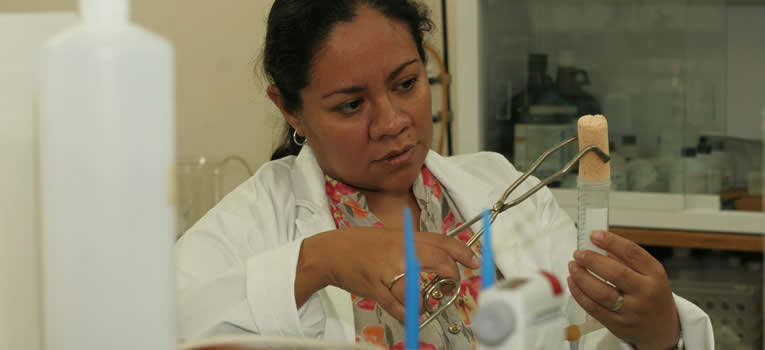
This laboratory develops the synthesis and research of new materials with catalytic properties for the remediation of fluorine and arsenic in water, and works with natural materials such as clays that allow to design filters.
In the laboratory of Synthesis of Absorbent Materials Applied to Environmental Remediation of UG, there has been a significant progress, with a double layer hydroxide that removes more than 90% of fluorine and 80% of arsenic, which allows to have water below the maximum allowed limits for human consumption.
The main objective is to put easy operating and low cost filters so they can be installed in communities and train their habitants for their use.
This laboratory also works in the hybridization of compound materials by two matrixes, one inorganic –clay soil—which will be the base because it generates a good matrix to incrust an organic material, in this case they use chitosan –compound obtained from shrimp's shell—and allows the material to have better mechanical properties making a resistant and flexible compound for two types of contaminants.
To finalize, Dr. Azuara invited all the public to work together with the University of Guanajuato, to generate an approach that society know and lives with the problems and UG is in science and technology to solve them.