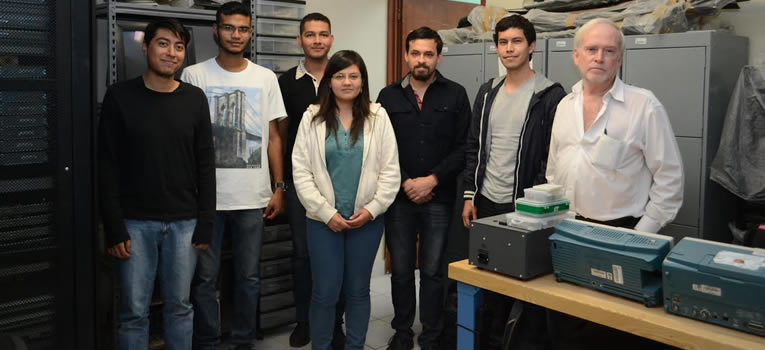
León, Gto., January 26, 2017.- A group of twenty students of Campus Leon of the University of Guanajuato (UG) works in projects where they develop technology to study and detect cosmic rays.
There is also high level research in the following projects: DUNE (Deep Underground Neutrino Experiment) which is an international scientific project with more than 1,500 collaborators, leader in the genre for the study of neutrinos, and, MINERvA (Main Injector Experiment to Study v-A), which is an experiment of elemental particles and data analysis with more than 100 collaborators.
The students work in the Laboratory of Elemental Particles of the Division of Sciences and Engineering of Campus Leon, advised by Dr. Julián Félix, who mentioned the importance of making scientific research and allow the students to design, create and test their own prototypes, as well as making academic stays at Fermilab, the largest laboratory of physics in its specialty in Chicago, Illinois.
Likewise, Dr. Félix highlighted the benefits obtained by collaborating with scientists from different countries and institutions, since it allows the professional formation of the students and continue the development of technologies that could be applied in telecommunications, as well as the study of the meteorological, and volcanic activity and make discoveries regarding the origin and evolution of the universe.
"The formation of new scientists may contribute to science and technology, as well as to the development of the country", mentioned the scholar.
High school students from the bachelor, masters and Ph.D. degrees in Physics, attend he laboratory; so, they continue working in elaborating detectors of cosmic rays, which are particles from outer space and whose energy can be used in different applications.
It is worth mentioning that Oscar Moreno and Everardo Granados, students of the major in Physics, obtained the two first places in the "National Contest of Scientific and Technological prototypes AIL-2015" where they presented the "Hybrid detector of cosmic rays with 24 detection channels" and the prototype "Construction, characterization and scientific application of a mini spectrometer of cosmic rays."
Likewise, the young researchers analyze data, product from the detectors of cosmic rays to be applied in the medical area and use neutrinos in clinical studies that don't affect the patient's health.