
 Guanajuato, Gto., February 3, 2017.- The world's day against cancer, was instated on February 4th with the main purpose to incite a reflection on what we want to do to encourage destined measures to reduce the index of this illness worldwide.
According the World's Health Organization (WHO), cancer is defined as "the fast multiplication of abnormal cells that extend beyond the normal limits and can invade adjacent parts of the body and spread to other organs. This process is called "metastasis". The metastasis is the main cause of death by cancer."
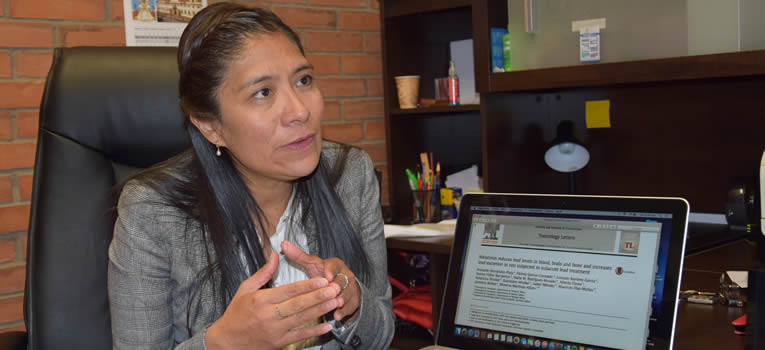
At the University of Guanajuato, different researchers work to fight this complex illness, an example, is the work of Dr. Minerva Martínez-Alfaro, who is responsible for the Laboratory of Pharmacy at the Division of Natural and Exact Sciences.
Dr. Martínez Alfaro was formed as a medic and then studied a master degree in Biochemistry and a Ph.D. in Molecular Biology of Cancer which she made in France at the International Agency of Cancer of WHO.
One of the main reasons that led her to specialize in some of her research on cancer, was since her work as a medic when she saw the patients didn't precisely died of cancer, but from the therapies that were very aggressive. "It was then when I realized that we had to study which were the specific alterations of this illness to find less violent medicine."
Dr. Minerva works with other researchers at UG that seek solutions to the problem of cancer; Dr. Juvencio Robles, who designs drugs against cancer and Dr. Miguel Ángel who synthetizes them. This is with the finality to generate drugs that attack specific cells and don't affect others in the organism.
The researcher explained: "for any substance to consume, several tests are needed. In the case of drugs, it requires to make toxicologic tests so they don't kill normal cells. Our dream is to make specific drugs for certain types of cancer and not affect other parts of the human body."
She indicated that "what we want to do is a protein that can interrupt the metabolic ways that alter the cells and so, won't have to irradiate people nor generate other illnesses."