
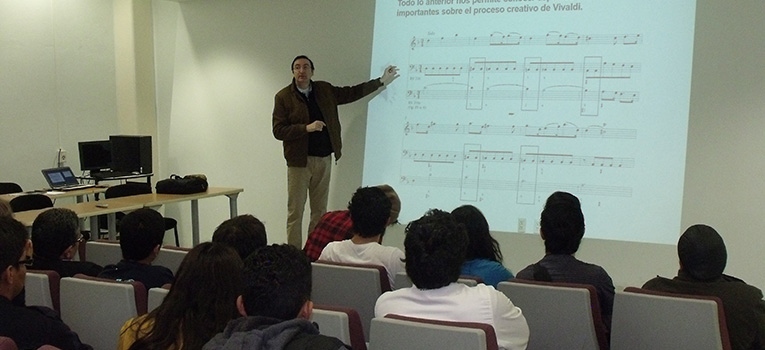
Salamanca, Gto., February 21, 2017.- As part of the program of the talks "Science is Culture" of the University of Guanajuato (UG), Dr. Fabrizio Ammetto, scholar of the Department of Music, presented in the Division of Engineering of Campus Irapuato-Salamanca, his conference "Music or musicology? Art or scientific research?".
The professor of the Division of Architecture, Art and Design of Campus Guanajuato, as a specialist of music production of the XVII & XVIII centuries, showed his most recent research, based in the reconstruction of musical pieces of mentioned centuries, he cleared that it is a process which is not always possible, because completing scientifically a musical play without incurring in the arbitrary creation, is complicated.
The students were very interested when he spoke about the musical play, which may be incomplete in the vertical level due to the lack of one or more movements or sections, as horizontal, due to the lack of one or more melodic lines.
Some examples of musical plays that remained incomplete are: The art of the fugue BWV 1080, of Johann Sebastian Bach; Requiem KV 626, of Wolfgang Amadeus Mozart; Symphony No. 8 "Incomplete" D 759, of Franz Schubert; Opera Turandot, of Giacomo Puccini; Symphony No. 10, of Gustav Mahler, and Concert for Viola, of Béla Bartók.
For Antonio Vivaldi's case, there are more than 40 incomplete instrumental compositions, among sonnets, concerts and symphonies, from which, Dr. Ammetto found that some pieces, accompaniments, harmonic structures, among other missing elements, were present in other Vivaldi's compositions.
This way, he made the respective reconstructions of (incomplete) Vivaldi's concerts for violin, organ and orchestra, RV 774 and 775, which only have the part for the violin solo, which is equal to a sixth part of all the composition. At the same time with the explanation of the process that was carried out in the reconstruction of these musical pieces, he showed the students the auditory result or final product.
Dr. Ammetto concluded his participation, mentioning that this process takes on a great scientific research, through the study of historical sources of the archive, the researcher had the idea of how were the organs that Vivaldi had in the years he composed RV 774 and 775, which contributed information for the reconstruction of these compositions.
These interpretative elements can be deepened thanks to the knowledge of reading different musical treaties, manuscripts or printings in the XVII & XVIII centuries, therefore, it is of vital importance the reading and knowledge of the history of art and musical to be able to recreate a reconstruction as faithful and similar as possible to the original works.