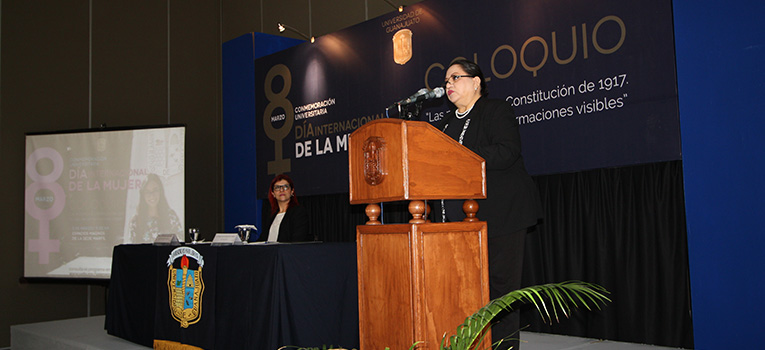
Guanajuato, Gto., March 8, 2017.- With a recognition to the institutional actions to treat the gender topic, the Rector of Campus Guanajuato of the University of Guanajuato, Dr. Teresita de Jesús Rendón Huerta Barrera, inaugurated the works of the Colloquium "Women and the Constitution of 1917. A century of visible transformations".
The colloquium is part of the university commemoration of the International Women's Day, for which they issued an open summon to propose reflections from all points of view regarding the role of women in different topics that are addressed in the Magnus letter.
To know, Education, Human Rights, Right to Vote, Indigenous groups, Culture, Work, Energy, Press freedom, Equality-Equity, Representativeness, Ownership of land and Health.
Dr. Rendón estimated that gender relationships are the ways in which society defines the rights, responsibilities and identity of men and women, this commemoration results to be precise, date in which the University of Guanajuato (UG) decided to convoke to analyze the Magnus Letter in this subject.
She highlighted that the work tables pretend to reflect towards the progress registered the normative order and the fight against inequalities both in men and women, since in their 100 years of existence, the Mexican Constitution has been reformed 699 times, and, among their most important modifications are the articles 4th, 2nd, 6th, 18th, 30th, 34th and 123rd which together allude the protection of women.
"It is true that a day like today, the most divulged precept will be the 4th Constitutional Art., because consecrates the equality between men and women, along the text, there is a series of mentions, more than 10, of capital importance for the presence and participation of the women", affirmed the Rector of Campus Guanajuato.
She observed that in the text from 1917, the presence of women wasn't in the Magnus Letter, but 100 years after its promulgation, the fight for equality is placed in the current text, hence the importance of the commemoration, but linked to the topic of a deep transcendence, such as the legal treatment of equality in the constitutional text.
"In all cultures and whatever their indicators may be of human development, the ascend and progress of women represents one of the greatest challenges that will only be achieved because of a cultural process", asserted Dr. Rendón, who also recognized the Mexico requires to strengthen its legal and political system to effectively guarantee the equality of people.
On her part, Dr. Claudia Susana Gómez López, Director of the Division of Economic-Administrative Sciences and organizer of the Colloquium, commented that in the first 100 years of the Political Constitution of the United States of Mexico, emerged the idea to analyze multiple readings that the Magnus letter could have.
Among them, the role of women in different subjects that are addressed in the Constitution, from the sociological, anthropological, legal, historical and economic point of view, and from there emerged the proposition of the first colloquium "Women and the Constitution of 1917. A century of visible transformations".
The objective was to build a space to gather, discuss, reflect and propose topics that address the Constitution and its influence on women.
Because the summon is public to expose a related topic, more than 30 authors with several profiles, scholars and students interested in the subject, and even civil society, informed the scholar.