
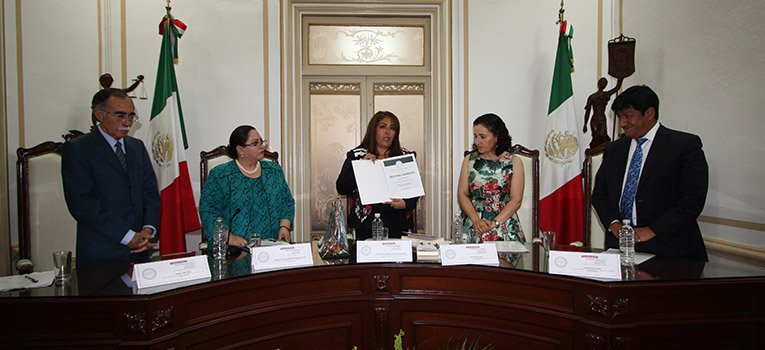
Guanajuato, Gto., March 24, 2017.- As a commentator of the book "Perspectivas comparadas de la Justicia Administrativa" (Compared Perspectives of the Administrative Justice), Dr. Teresita de Jesús Rendón Huerta Barrera, Rector of Campus Guanajuato, pronounced for the creation of a center of studies of the administrative activity.
The book, coordinated by the researchers of the Research Center and Economical Teaching (CIDE), Adriana García García and Sergio López Ayllón, was presented in the facilities of the Tribunal de lo Contencioso Administrative (TCA), where they gathered, among others, the Secretary of Transparency and Accounts, Ma. Isabel Tinoco Torres, and court magisters.
Such text, as explained by Dr. Pedro López Rios, professor at the Division of Law, Politics and Government (DDPG) of Campus Guanajuato; offers excellent reflections in 10 systematized essays in three areas in compared models of administrative justice.
The thirteen authors, four Mexican and nine foreign (six from Latin countries and three American), refer concrete experiences on compared administrative jurisdiction systems of 18 countries of America and breakdown specific problems.
In her comments, Dr. Teresita Rendón shared that in the book there is a series of contributions that not only TCA must know, but all the courthouses in the country, "next to be Administrative Justice Courts", since they are contributions that will be the everyday doing of the same after the implementation of the Anticorruption National System.
Is a work that incites to technical reflection, she said, with methodological rigor "as the CIDE has us costumed, pioneers in sociological research and the circumstances that are found in the courthouses", and the coordinators of the book toured all the courthouses of the republic and made a magnificent work on the aspects they should improve regarding administrative justice.
It would very important, commented the Rector, that TCA grew in a related competence, which are the materially administrative acts from the Legislative and Judicial powers; if it were the consolidation of their competence, there would be an extraordinary advance in administrative justice, where the Contencioso Administrative de Guanajuato has always been the pioneer.
She wondered if it wouldn't be the moment to widen the competencies of the Tribunal Contencioso and at the same time, she strongly criticized toward the anticorruption topic, that adhered to the competence of the contentious courthouses, "because they detract their essence, their jurisdictional nature."
"Turns out that, the administrative courthouses must not only be experts in the development of jurisdictional power but also be prepared for the exercise of lus Puniendi (sanctioning faculty of the State)", mentioned the Rector of Campus Guanajuato.
In her opinion, that is a counter argument, since she considers that it had a subject of the competence of other instances, not administrative courthouses, "but law is the law and we must oblige", indicated at the same time seeing that would imply "many preparation journeys."
It was then when she manifested that for TCA it could be a key moment to form a new center of studies or analysis of administrative activity, which would serve to prevent many mistakes in the public administrations, for example, when there are many subjects in transit, of human settlements, transport, something is wrong with authority.
M. Silvia León-León, professor of DDPG, also commentator of the book, mentioned that the coordinators are from CIDE, and it is about the compared perspective of justice for the citizen and the efficiency of the public administration.
It is a work that allows to reflect what we know, learn what we don't know and in the time, apply it, she said; while M. José Roldán Xopa, author of one of the 10 essays of the text, agreed with the manifested with Dr. Rendón Huerta Barrera.
Finally, Magister Antonia Guillermina Valdovino Guzmán, TCA's president, commented that texts such as this, work and help for the improvement in providing justice in the country, which is an updating stage through the implementation of the Anticorruption National and State System, which will provide new attributions.