
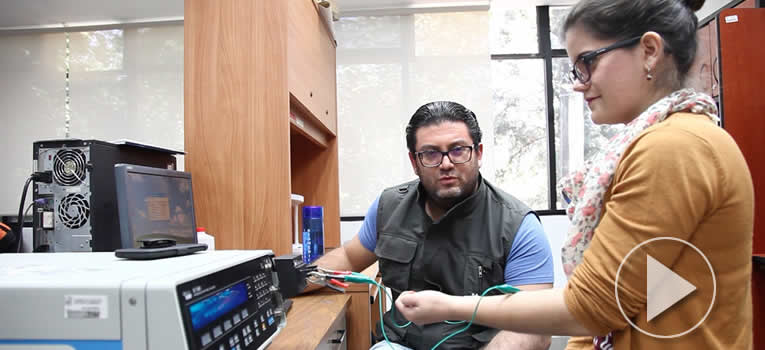
 León, Gto., April 10, 2017.- Currently in Mexico, the clinical tests that are used in lung disease are invasive, uncomfortable for the patients, expensive and most of the time inexact. Hence, a group of researchers of the University of Guanajuato (UG) works in a new technique, which uses the principal of electrical impedance and eliminates the disadvantages of the most common clinical tests.
The electrical impedance is a property all the materials have, "the resistivity of an electrical current", explains Dr. José Marco Balleza Ordaz, ascribed researcher to the Department of Physics Engineering, at Campus León of UG. The medical applications began around the 80s in monitoring the pulmonary function and has extended to other areas.
This technique allows, in addition, to obtain images to use them with several medical objectives, in pulmonary pathologies, in the detection of knee injuries, detecting bladder drain (in disabled patients, who have no control of their sphincters). Also, they can use it to detect the progress in muscle exercise during sport lesions, which will help to avoid lesions. All these are research lines that are explored at UG, mentioned the scholar of Campus León.
The University of Guanajuato lead in pulmonary research, in pneumology. We don't want to leave it only in detection and monitoring of the respiratory pattern, you could say that we are the only university that currently has this research in the country, mentioned Dr. Balleza.
One of the most advanced lines is monitoring the circulating pulmonary volume. "The methods that exist are uncomfortable and inexact to measure the air that mobilizes the patient". These are invasive, and in healthy people there is no problem, but when they are sick (asthma, emphysema, lung cancer), the patient's valuation is complicated.
The great advantage of using electrical impedance is that technique is non-invasive. "Parting from four electrodes placed in the thorax, it is possible to obtain a signal in terms of impedance corresponding the volume of air we are breathing".
UG researchers also work in a study to analyze through electrical impedance, the circulating volume in patients with tobacco habits. It is so, that Mexico, --explains Dr. Balleza—lacks efficient tests to diagnose patients with this habit –they only have spirometry—and other very expensive. The impedance apparatus is radiation free, cheap and, therefore, acquirable by anyone. The physician could detect the pulmonary ventilation, analyze its variables and have a more precise diagnosis, sustains the scholar.
Another of the applications explored by UG researchers is the detection of knee injuries. Currently, the methods are by image and extremely expensive. Besides, there isn't a technique in hospitals that allows to detect injuries having the knee in movement. With the impedance technique, we place four electrodes in the knee, "and through static conditions and in movement, we are capable to detect minor swelling in the soft tissue".
The scholar cleared that the project's objective is not to substitute the current diagnose methods, but add one more, and for its cost, to be reachable by the population.