
 León, Gto., April 14, 2017.- The University of Guanajuato is leader in two selected research programs in the program of Themed Networks of the National Council of Science and Technology (CONACYT).
These networks are defined as the voluntary association of researchers or people with interest on collaborating to address a national priority problem. Each network is coordinated in a schooled fashion by an Academic Technical Committee (CTA).
The main objective of this program is to promote the interdisciplinary collaboration to address complex problems in topics of national interest in an articulate manner between actors and academy, government and society.
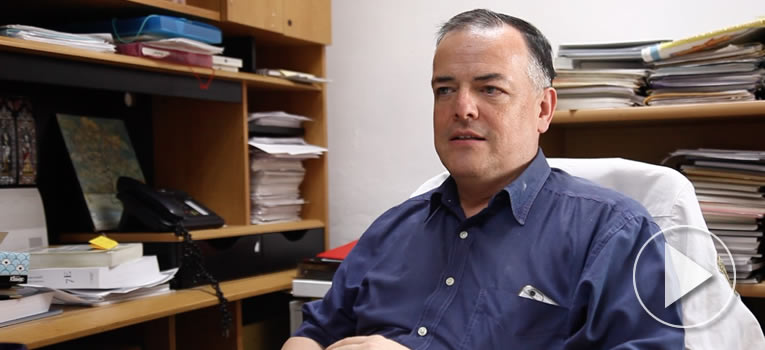
One of such networks is the Themed Network of Soft Condensed Matter led by Dr. Alejandro Gil-Villegas of the Department of Physics of the Division of Sciences and Engineering of Campus León.
The researcher at the University of Guanajuato commented that through the collaboration of Scientists, students and scholars from several institutions of the country, is how they will function throughout the year, with different activities regarding the topics and its scientific reach.
He highlighted that the subject has multiple applications in several sectors of the industry, precisely, due to its great flexibility, so they can make products with polymers, liquid crystals, biological membranes, just to mention some.
Also, soft condensed matter can be used in the paint industry, the pigments, coatings, films, adhesives, as well as petro-chemistry, nanotechnology and food industry.
Because this initiative was selected by CONACYT, the network members will benefit with resources to carry on activities that will allow to address the problematic they are working on.
Dr. Alejandro Gil-Villegas distinguished that it is a great honor and a great responsibility for the University of Guanajuato, to take the lead in this project but are really committed to continue making a quality work where also the academic bodies of Mechanics and Statistics participate, as well as the Electronic Chemistry and Biomedical. In this project, the active collaborators come from different institutions, among them, the Universidad Nacional Autónoma de México and the Universidad Autónoma de San Luis Potosí.