
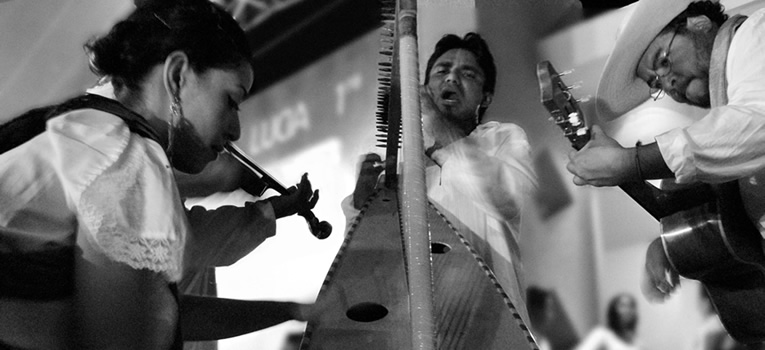
Researcher of the University of Guanajuato creates a study on the use of the harp among indigenous towns of Mexico.
Guanajuato, Gto., May 16, 2017.- The harp is an instrument with several myths in some indigenous societies in our country, who have anthropomorphized the instrument giving it a life of its own which creates music to accompany certain offerings.
Dr. Alejandro Martínez de la Rosa, researcher of the University of Guanajuato in the Department of Cultural Studies of Campus León, was interested in studying the harp and began with a research he developed thanks to a scholarship granted by the National Council of Science and Technology (Conacyt).
This allowed him, next to other collaborating researchers and students, to develop a research in ethnomusicology.
The harp arrived in Mexico with the Spanish, who, through sacred music, tried to evangelize the indigenous people. So, with time, these people integrated the sounds of the harp in their own music, used in many cases, in different rituals.
The name of this 3-year research by Dr. Martínez de la Rosa and his colleagues is "El uso del arpa entre los pueblos indígenas de México" and its main objective was to define and give evidence of the use of the harp in modern times, which indigenous groups still use it, besides explaining the myths that surround the instrument.
For this research, Dr. Martínez de la Rosa, visited different regions where the harp is still played in popular music, however, he expressed that this act is losing and the new generations are less interested by ancient music. The visited states were Oaxaca, Chiapas, Puebla, Durango, San Luis Potosí, Sinaloa, Michoacán and Veracruz.
One of the conclusions the researchers reached when they studied the social-cultural ambience of such musical manifestation, was that every region interprets its own music; if there are similarities, each entity distinguishes by the different tones made by their harps, hence, there isn't only one kind of music.
The study implied the anthropomorphism of the instrument in the different indigenous regions composed by the: Yaquis, Mayos, Nahuas, Mazatecos, Tzotziles, just to mention some ethnic groups. Same that give an animistic treatment to the harp, meaning, they give life to it and treat as a person, they name its parts as if were a human's: head, feet, back, etc. Also, they give it food and drink, before a party begins.
One the fundamental purposes of this academic work, is to raise awareness and generate knowledge on the musical expression of the harp, which is part of a national identity and the cultural diversity that exists in Mexico.
The research results can be consulted in large format book that is about to be published, composed by several essays on harp music created by the indigenous communities. The publication will be illustrated with several photos that show the traditions. In addition, they will publish CDs with recordings from the different regions.
Dr. Alejandro Martínez de la Rosa has a major in Communication and Journalism of the Universidad Autónoma Nacional de México (UNAM), he was a winner of the 3rd national place for the best thesis in communication sciences by the Consejo Nacional para la Enseñanza y la Investigación de las Ciencias de la Comunicación (CONEICC) which was about the first four books of Carlos Castañeda.
He studied for two years in the National School of Music of UNAM, in ethnomusicology. He has a master degree in Latin American Studies, with a thesis on the History of the Independence in Bolivia and a Doctorate in Humanities, of the Universidad Autónoma Metropolitana unit Iztapalapa.