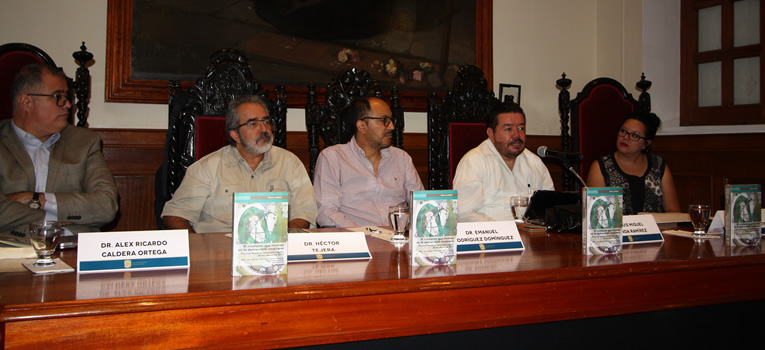
Guanajuato, Gto., May 16, 2017.- In the Hall of Acts of the Division of Law, Politics and Government (DDPG) Campus Guanajuato of UG, was presented the book "El momento que vivimos en la democracia mexicana. Procesos locales y nacionales a partir de las elecciones 2015", which was coordinated by the scholars Héctor Tejera Gaona, Emmanuel Rodríguez Domínguez and Pablo Castro Domingo.
Such text was edited by the Universidad Autónoma Metropolitana unit Iztapalapa and has the collaboration of three professor-researchers of the University of Guanajuato (UG), among them, Dr. Vanessa Góngora Cervantes of the Department of Public Management who expressed to be proud next to her academic peers, to share this achievement.
She mentioned that at the end of the last electoral process, UG received with pleasure all the researchers in the seminar "Democracia, Cultura y Ciudadanía" in the context of 2015 elections. In the seminar, progress from the works was presented and there was an opportunity to exchange opinions and receive observations of the analysis of the voting processes.
Now, with this book, the main observations of twenty researchers are known, on the path walked in the 2015 voting processes and the expected panorama for Mexican democracy. Dr. Vanessa Góngora Cervantes, was the moderator of the book presentation.
In his comments, Dr. Alex Ricardo Caldera Ortega, Director of the Division of Social Sciences and Humanities of Campus León, considered that the great contribution of the book focuses on proposing a deficit of democracy and existence of authoritarian traditions, but it must be recognized in institutional terms, which have had changes in the last 20 years.
Dr. Luis Miguel Rionda Ramírez, professor-researcher of UG and councilor of the Instituto Electoral del Estado de Guanajuato (IEEG) said to be satisfied for finishing years of work, in a book that addresses the problem of regions, of entities and cities of Mexico.
It is not a text of political anthropology, he sustained, but a volume that supports in four chapters that exhibit diverse academic traditions, but linked with the common interest in the study and political electoral configurations, inside a country that doesn't define yet in its political renewal schemes.
He observed that the authors deploy cases and causes, from moving the electoral maps until redefining the reach of the traditional political actors, and in this moment, where the parties are in crisis as well as leaderships and traditional political uses, the 2015 elections defined the future.
Also, Dr. Emanuel Rodríguez Domínguez and Dr. Héctor Tejera, who agreed on watching if the text was edited at UAM, it began here in Guanajuato with the expose reflections in the seminar.
Dr. Tejera highlighted that this book wouldn't exist without the participation of UG, its researchers and the facilities for the seminar that gave place for the book, which, he said, despite the topic of elections, it really refers to democracy, the constitution of social relationships based in processes of power that exist in different places in the country and democracy is the context.