
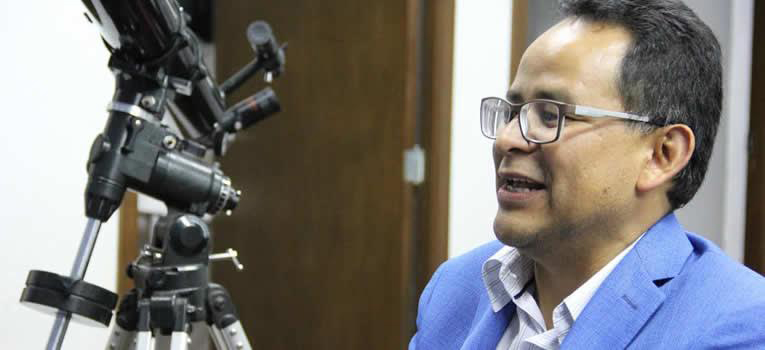
Guanajuato, Gto., May 26, 2017.- Campus Guanajuato of the University of Guanajuato will have three radio telescopes which will allow the institution to position as one of the national leaders in radio astronomic research, since Mexico has no public or private institutions with this kind of infrastructure, until now.
Dr. Miguel Ángel Trinidad Hernández, professor researcher of the Department of Astronomy of Campus Guanajuato and leader of the program of radio astronomy, mentioned that the arrival of the three radio telescopes will allow research to know if it is possible to find water masers emissions in planets outside our solar system.
"The project emerges from the Institutional Summon of Strengthening for the Academic Excellence 2015, in the category of Support to Post-Doctoral Researchers, in which it is proposed to seek a very particular radiation called maser emission, which can be found in stellar formation regions, in stars and even other galaxies," he said.
With the 5.3m diameter radio telescopes and a receiver that observes at 22cm, this project's research will focus in the analysis of stellar formation regions, where stars are born, but will also study dying stars, which emit the type of radiation to study.
And, what the project leader says, the observation reach of the radio telescopes which are being installed at the La Luz Observatory, is related with the signals emitting from the regions to observe, "without a problem we can watch objects in 1 kiloparsec distance if the emission is intense enough (...) this astronomic scale distance is equal to the distance from earth to the sun by 200million times."
Its installation has reach beyond the mere radio astronomic research, since in the future, they pretend to begin several multidisciplinary projects in the own institutions, such as propitiating the research regarding telecommunications, include professionals from several areas to incur in the construction of radio telescopes and work closely with the Mexican Space Agency, with the purpose to share experiences and sum synergies to develop this area throughout the country.
Dr. Trinidad Hernández revealed that a second part of this project, "considers the creation of a laboratory of radio astronomy, which will have a direct impact in teaching, particularly in the postgraduate of Astrophysics and some majors or engineering of the institution."
The radio astronomy group of the Department of Astronomy of Campus Guanajuato is formed by: Dr. Josep María Masqué, Dr. Solai Jeyakumar, Dr. Lucero Uscanga, Dr. Carlos Alanias Rodríguez Rico & Dr. Miguel Ángel Trinidad Hernández leading; also, stands out the support from Dr. Agustín Ramón Uribe Ramírez, Director de la Division of Natural and Exact Sciences of Campus Guanajuato.