
Oviedo, España, May 29, 2017.- "The artistic disciplines are a powerful conductor of the memory of towns" so considers Dr. Francisco González Compean, whose work "Las mujeres de Pénjamo. La marcha de las rehenes" will be the first piece played in the Europe tour by the Symphony Orchestra of the University of Guanajuato (OSUG) in Oviedo, Spain.
Frankly, he recognizes "as a creator and an executor, in my opinion, I'd say that you don't have to worry about something else but to create; however, there are implicit functions in the artistic creation: we remind the societies, the empires, what you imagine through art. We know about prehispanic culture, because of its visual art, for that type of documents. We know about Greece for its architecture, for its art, its music, its dances and I think it can be art, music, any artistic discipline a very powerful conductor of the memory of towns."
While in this context, he received OSUG's invitation to compose a symphony poem to be included in the OSUG's 65-year commemorative tour; he decided to poke around historical research; and with the help from the historian and researcher of the University of Guanajuato, Dr. Rocio Corona Azanza, he decided to honor the memory of women from Pénjamo who were imprisoned during the Independence war.
"The symphony poem titles "Las mujeres de Pénjamo. Las marchas de las rehenes" is based on a historical research from a colleague of the Department of History of the University of Guanajuato (UG). Being commissioned by OSUG to compose, we reviewed the orientation and instrumentation but with prior symphony poems I'd thought to maintain a line that had to do with historical situations of Mexico, heroic figures or particular situations, this story meant to be honored", he affirms.
On the matter, he recognizes is a barely known event in Mexico and in Guanajuato where Mexico's independence war occurred "when Iturbide was with the Realistas, as part of the war mechanics and historical contexts, he requests a war band in which all women related to the Insurgents must be apprehended immediately (...) we are not certain about how many but the time testimony tells us they were around 300 women, which, with no trial, were taken prisoners."
In an interview in Oviedo's downtown, the composer of Guanajuato and UG graduate, explains that the women had to march to the city of Irapuato at troops' rhythm. When they arrived, they were imprisoned in dungeons for a long time. From that point, who survived, some died during the march, were forced to march to Guanajuato where they were in a dungeon again. They sent letters to the viceroy claiming for mercy and, when they got an answer, there were only 20 women left; it means, more than 200 women died because of the abuse, of the imprisonment and the heartbreaking situations they went through.
Hence, composing this work was a unique opportunity to tribute the memory, maintain the memory alive, because it is important we know our history and we can contextualize when this occurred.
Dr. González Compean is honored and proud "to think that I was commissioned to this piece with two other composers to commemorate the 65 years of out Symphony Orchestra with life dreams come true, childhood dreams", while talking about the premiere of his play in Europe and that it was selected to open the first OSUG concert in this tour.
Diversity is also Mexico
The piece of Dr. González Compean is part of the Mexican contemporary music, which OSUG's head conductor, M. Roberto Beltrán Zavala, has included in the European tour programming. Dr. Compean considers "when we think in other countries, in the foreign, outside, we have stereotypes and sometimes we find ourselves who are promoting these stereotypes by staying in a comfort zone. We are not travelling with any of the pieces that are part of the usual repertoire of the tour of Mexican symphony orchestras through Europe, which are great, but Mexico is not only that, Mexico is also the contemporary, what is modern and eclectic and the three pieces that have been commissioned for this tour contrast each other and with that variety and diversity it is also Mexico."
The also UG's professor-researcher considers himself a great fan and "to a certain point, humbly, heir of the Mexican nationalisms. I took my degree with Héctor Quintanar who inherited the workshop of Carlos Chávez but talking with Roberto Beltrán about the repertoire for this tour, which certainly is not the standard of the Mexican orchestras, I think is a very wise decision and bet."
A consolidated career
Dr. Francisco Javier González Compean is currently a full-time professor-researcher at UG; he is the Director of the Division of Architecture, Art and Design (DAAD); he entered UG as a student, where he was a student of M. Héctor Quintanar.
Since high school he was composing music for theater mainly. It has been a constant work as a composer, in collaborations with other musicians, he has been in numerous pieces; and is an executive composer at OSUG and also pianist.
His music has been played in great scenarios, his first premiere in Europe was a sonnet for piano in the Max-Joseph-Platz hall in Munich, Germany; in Spain, he was selected twice in the Young Composers Encounters; in Mexico, his music has been played in Bellas Artes, in the Manuel M. Ponce Hall. His first premiere with an orchestra was with OSUG, in the 4th Festival of Callejón del Ruido.
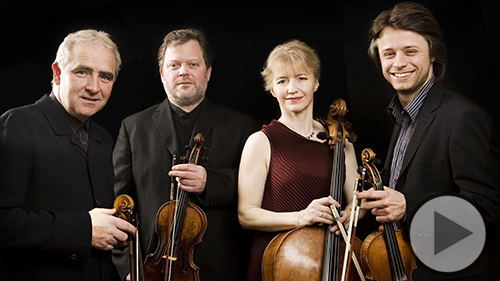
Tonight, OSUG will being its tour in Europe playing the symphony poem "Las mujeres de Pénjamo. La marcha de las rehenes", in the concert which will be held at the Principe Felipe de Oviedo Auditorium, whose program includes the B. Martinu concert for string quartet and orchestra, accompanied by the prestige Brodsky quartet and will finish with Shostakovich no. 5 symphony.
Esta noche, la Orquesta Sinfónica de la Universidad de Guanajuato iniciará su gira por Europa interpretando el poema sinfónico "Las mujeres de Pénjamo. La marcha de las rehenes", en concierto que se llevará a cabo en el Auditorio Príncipe Felipe de Oviedo, cuyo programa incluye el Concierto para cuarteto de cuerdas y orquesta de B. Martinu, acompañados por el prestigiado Cuarteto Brodsky y terminará con la Sinfonía no. 5 de Shostakóvich.