
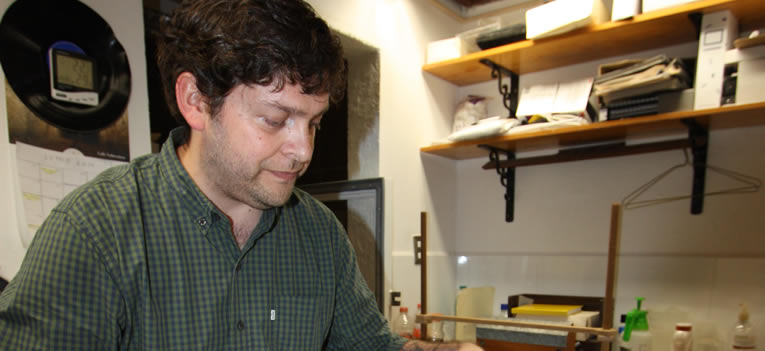
 Guanajuato, Gto., July 23, 2017.- For Andrés Fuentes Basurto, promoter of the Area of Conservation of the Coordination of the General Archive of the University of Guanajuato (UG), is a pleasure more than an everyday job in restoring ancient books.
Foer eight years, the graduate on Restoration of Goods and Buildings by the School of Conservation and Restoration of Western Guadalajara goes to his privileged work place: The Library "Armando Olivares", in the Reforma garden of the capital.
Currently, next to her partner Susely Hernández Pérez, graduate from the degree in Visual Arts of the University of Guanajuato, specialize in the rescue of the cultural document in paper support.
In an interview, Fuentes explained that the strategy to restore the documents that the General Archive preserves, is based first in a previous diagnosis, the identification of the material to be restores, and once in the workshop, it takes in average a month to restore nearly four volumes.
Of course, it depends on the type of decay, for example, right now they are intervening the back cover of the Dr. José María Luis Mora, and in this collection, they selected the books that had opening problems and tears in the back to return them to the shelf and be useful again for consult.
He informed that the "Armando Olivares" Library, with an archive of approximately 60,000 volumes; has the safekeeping of nearly 2,000 volumes of the Dr. Mora collection, which is fragmented, since there is a part here and another in Mexico City, the Mexican historian and politician was avid for human and politic sciences.
From the total archive, he indicated, 90% of the books require some intervention, some are low impact, other are high; for which they intervene to wash the paper when they're stained for example, with mud, fungi or bacteria, they're washed with special solutions and re-integrate to a bookbinding.
They have also made reinforcements of grafts in historical papers that have engravings or documents that can't be found, also, they have completed support interventions in scrolls.
He confirmed that around the library there's a lot of noxious fauna and flora: rodents and insects who shred paper and other minor insects that nest inside the books. For that, there is a plague control program and they limit the access of this fauna and, fortunately, there hasn't been any accidents.
They sought an environment friendly strategy, and found a Spanish company, specialized in safekeeping historical papers against noxious fauna, which has given excellent results.
To restore, he explained, you have to make a small historical research and, once you have the healthy parts, it is reconstructed using the technique used when the document was created, even, if the resource is available, you can get some decorative elements of that time.
But basically, is the stabilization, he said, "and they respect the marks made by time, never pretend to modify, but as people with scars, they are respected as being part of their history and identifies it as unique."
He exemplified there is a book of Hypocrites with decay by blood stains, which infers it was possibly used in a surgery process, perhaps the medic had it with him at that moment and, although the stain could be removed with washing processes, it is not done since it is an evidence of its history.
He made a point that for any restoration, all the decisions are collegiate, no one has the final word but through several specialists the decision is made, meaning, between the Coordinator of the General Archive, the Promoter of the Safekeeping, restorers, specialists, historians and, sometimes, chemists and biologists.
He revealed that they are working in two archives now: The one of the "Armando Olivares" Library with a fungal disinfection and the Historical Archive with the preparation and reinforcements of the material that is going to be exposed in later dates in the Museum of the Palace of Powers.
The processes in this case, are applying reinforcements with Japanese paper and adhesive based on purified starch, intervention which will allow the object to be handled and placed in display cases without a greater decay.
He mentioned that the preventive conservation exists, and it allows to deaccelerate the decay processes with strategies such as the elaboration of "guards" of paper designed to absorb noxious chemicals, handmade boxes, where the books remain until the moment of restoration and avoid damage to near books.
Fuentes commented that they also work with wood, glass, oils, minerals and textiles, for example a block of keys from the Ing. Ponciano Aguilar collection, circa the XIX century, arrived "welded" together and they have managed to completely clean them through chemical restoration and micro excavation to free them of rust and dirt.
Photo Gallery