
Celaya, Gto., July 9, 2017.- In a study published in 2014 in the scientific magazine The Lancet, Majid Ezzat warned that "If obesity continues to rise at this pace, for 2025 a fifth of the men (18%) and women (21%) will be obese".
In Mexico, according data of the Mexican Institute for Competitiveness (IMCO) in 2015, more than half of the Mexicans (60.6 millions of people) suffer overweight or obesity.
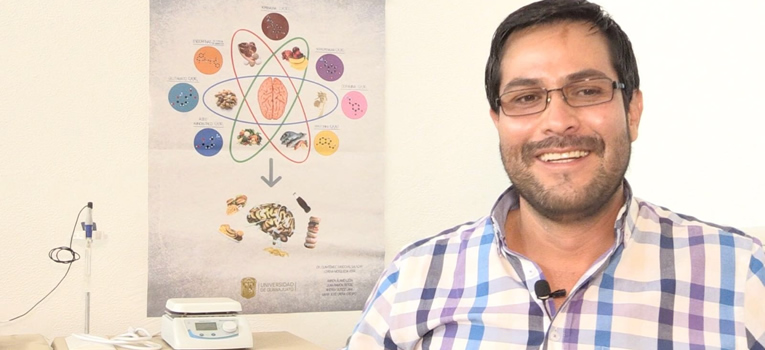
Preoccupied to raise awareness in the general population on a healthy diet, Dr. Cuauhtémoc Sandoval Salazar, professor-researcher at the Division of Health Sciences and Engineering of Campus Salvatierra of the University of Guanajuato (UG), makes research on strategies based on antioxidants that can diminish the brain damage derived from the hypercaloric diets.
Dr. Sandoval, specialized on Biomedical Sciences oriented in Neuroscience, highlighted that the impact is aimed to prove the population the consequences of not being careful on what you eat every day since the damage is degenerative and can be irreversible.
The Neurobiology laboratory is where they make projects related with the negative effects that the hypercaloric diets, high in refined sugar or high in trans fats have, which affect the brain. Also, personnel of nutrition, medicine, and psychology contribute and they are about to incorporate in nursing.
Likewise, in this project they evaluate the oxidative damage produced to the lipids and proteins in the neurons and how the previous can affect the release of GABA neurotransmitters (inhibiting substance that decreases anxiety), Dopamine (implied in pleasure, memory and learning) and Serotonin (regulates the moods, and body temperature), among others.
A primordial characteristic, that the brain circuit is involved in the addiction of other psychoactive substances is the same for the addiction to food and for which there is a bad eating habit.
The psychoactive substances can be natural and synthetic, both can inhibit pain, alter the mood state of the perception of who consumes it.
Dr. Sandoval explained that there is also a dependency to food high in fat, hence, it is not that simple to stop consuming it from one day to another, since the brain is used to this kind of food.
"If the consumption begins to be chronic and you don't healthy food it is likely you begin to affect these processes of memory-learning", he mentioned.
Something interesting mentioned by UG's researcher, was about a swelling process unseen at simple sight, same that unbalances the cellular homeostasis in the brain and this can generate anxiety or depression. "A form to find food alternatives is based on nutritional education", he reaffirmed.
Dr. Cuauhtémoc Sandoval mentioned that an area of opportunity is the student community of the degree in Nutrition, so they can the base for the generation of campaigns or interventions to raise awareness in the population. "A change, for small as it may be in the diet towards healthy, will bring a lot of benefits", he said.