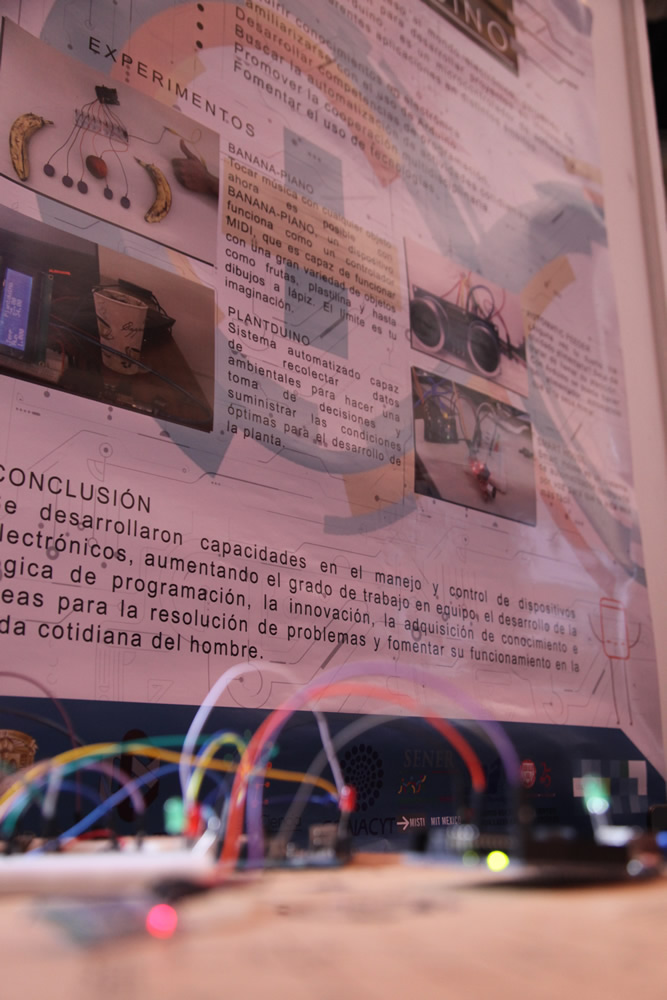
Guanajuato, Gto., August 4, 2017.- With an exhibition of posters, participants of the Science Clubs 2017 printed what they learned during a series of activities designed by instructors from Harvard, Stanford, Boston University, the Universidad Nacional Autónoma de México (UNAM) and the University of Guanajuato (UG), among other prestige institutions.
Science Clubs are intensive courses designed and taught by researchers, who include practical immersion workshops and scientific activities for students, with the intention to encourage scientific callings.
This initiative emerged in Guanajuato, and currently has six more venues: Chihuahua, Ensenada, Monterrey, Puebla, Mérida, Oaxaca and Xalapa. Also, it has replied in other countries such as Bolivia, Peru and Brazil.
As every year, UG received the students who participated in a selection process to attend courses in which they learned about topics as the influence of the microorganisms in food flavor, the use of sun light, how is medicine designed and the fundaments of quantum mechanics, among other topics. All through experiments, demonstration and the construction of programs or devices created by the youth.
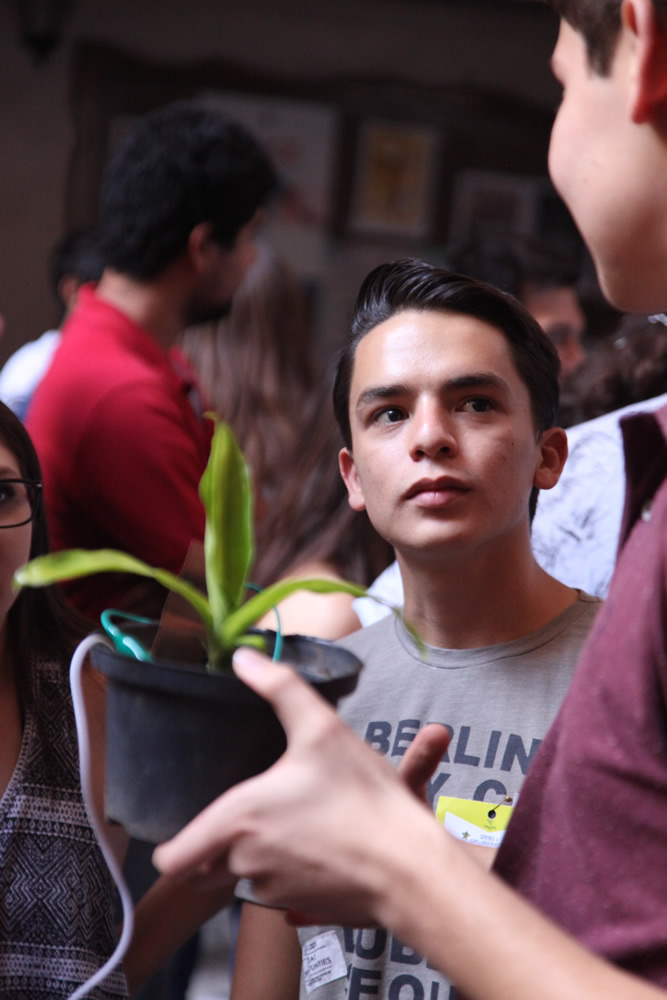
An example of this, is the work done by Prof. Claudia Érika Hernández Morales, from HS Guanajuato, who together with Prof. Guillermo Caballero Tinajero, from HS Salvatierra, developed the topic biological oscillators.
This project works with a plant commonly known as "sapito" (little toad), which has the peculiarity that in the day is totally open and closes at night, so it has a 12 to 12 cycle. "What we did was apply controlled temperatures and see its behavior, such as the electrical conductivity, and so we realized that it is a biological oscillator, constantly oscillating in its natural mean, when we controlled it, we could see that it reacts to light but it does have its 12 to 12 rhythms", explains the professor.
She added that the most relevant is that "we let the kids explore, we tell them what we wanted to do and they are developing the workshop.
They have worked as a team, discuss the results among them and are very participative". Prof. Caballero agrees with her; he sustained that the interest and work of the youth went above their expectations.
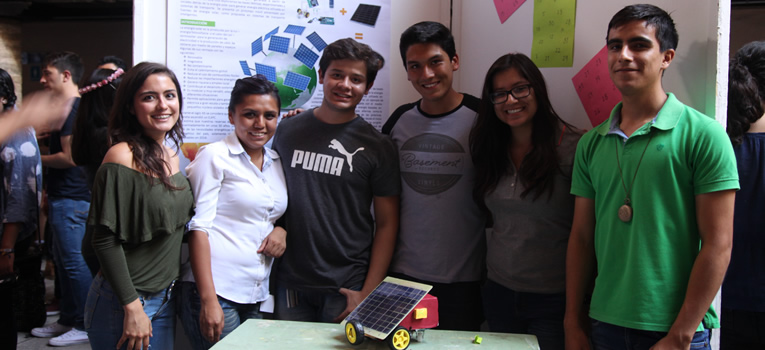
One of the purposes of the Science Clubs is to create student networks, of Mexico and abroad, who shared the information and support in projects of common interest. So, Eduardo Huerta Laguna, student of the Benemérita Universidad de Puebla (BUAP), who worked in a project about sun light as a clean energy source, mentioned that the club had 16 participants from different states, and there was an important collaboration, so they expect this kind of projects to be implemented in a large scale.
This time, in Guanajuato were taught eleven courses, for free, since Science Clubs are constituted as non-profit civil associations, and have the support from the National Council of Science and technology, the Department of Energy, the Mexico Foundation in Harvard and the Massachusetts Institute of Technology, among other educational institutions.
The closing ceremony of the Science Clubs 2017 venue Guanajuato will be held on August 5th in UG's General Hall. For more information about the program, please visit www.clubesdeciencia.mx
Photo Gallery