
 Celaya, Gto., August 31, 2017.- "Los Arenales" is a small town in the limits of the community of San Miguel de Octopan, from the city of Celaya, its habitants are used to the smoke from the brick factories, because of their routine they are not aware that living like that decreases the quality of life, and if they are aware, the habit has been winning every day.
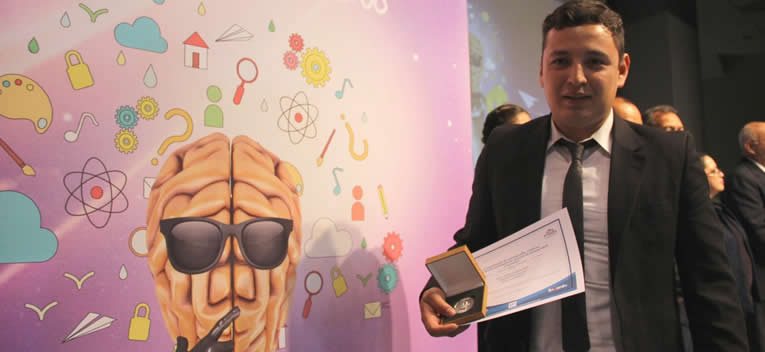
Fernando Gómez Guerrero, a student at the University of Guanajuato (UG) Campus Celaya-Salvatierra, took to the small town his project "UG's Community Liaison", designed to help transform the life of the habitants in the most unprotected regions.
In an interview, he mentions how in "Los Arenales" the dehydration symptoms in at least a third of the population are ignored, and how most children suffer respiratory infections.
The project obtained the first place in the category of Social Entrepreneurship in the twelfth edition of the Contest of Creativity and Innovation, organized by the University of Guanajuato in collaboration with the Mexican Institute of Industrial Property.
When he was questioned how the project emerged, he told about his initial interest to consolidate a multidisciplinary program that wasn't just mere assistance, but be a deep transformation; to help mitigate the levels of poverty, delinquency, marginality and increase the levels of education, employment and health. "It is time that we the young become the force to create a change. We haven't developed an economy at the service of people, but at the service of the capitalists", he emphasized.
The actions of the project begin with a diagnosis, "we go to the communities to detect the problems they have and prevent their development; once identified, we begin to design the projects and programs with which we will provide solutions."
The student of the Civil Engineering degree, tells that is how they detected that in "Los Arenales" they have serious health, infrastructure, education, and nourishment problems, among others, and through the project's strategies, they have detected problems in other communities such as "La Trinidad" (Las Granjas), also in Celaya, and in Palo Blanco, at Salvatierra, where a group of enthusiastic youth contributes to create favorable changes in the families who lived there.
When he was questioned how the project works, Fernando tells that it is about an interdisciplinary project in which students from different degrees and universities throughout the country participate in re-structuring the social waive through different programs, covering the basic needs of the people and promoting a healthy life culture.
For example, he says, the community "La Trinidad", located in the city of Celaya, doesn't have drinking water. He found that 65% of the population have an addiction: tobacco and alcohol are the most common, and they are at risk due to an increment in acute respiratory infections and hepatic diseases or acute renal failure, respectively.
He explains: "In a joint and coordinated way, we go to the communities and give support to the people who, according to our diagnosis, are at great risk. I.e., if we want to reduce addictions in children and youth, we will seek to provide new identity features through sport strategies where the youth can use their sporting abilities and grow in an overcoming, fellowship, transcendent and productive ambience. Here is where the infrastructure work comes in, designing and creating sport areas so they can have those spaces to develop. The lists and brigades who will come to give the proper support are ready and organized, this is what we call "The National Journey of the Community Liaison."
Today, the project has the participation of the engineering students from different branches such as: Civil, Environmental, Architecture, Regional Development, Agroindustry, Agricultural, Biotechnology; and from Health: Nursing, Psychology, Dentistry; from different institutes and universities such as: Technological Institutes of: Roque, Zitácuaro, Celaya, Tijuana, Valladolid and Mérida; and universities of: Celaya, Colima, "Autónoma de San Luis Potosí" and "Autónoma de Coahuila".
Because of the reach they foresaw for the project, he assures "it is a ray of hope for our nation. I trust in people. I trust in my country. I see hundreds of students working in the project, creating the required changes."
Photo Gallery