
 Guanajuato, Gto., September 16, 2017.- An element of our everyday life and with which we subsist is money, but have we asked ourselves, what money really is?
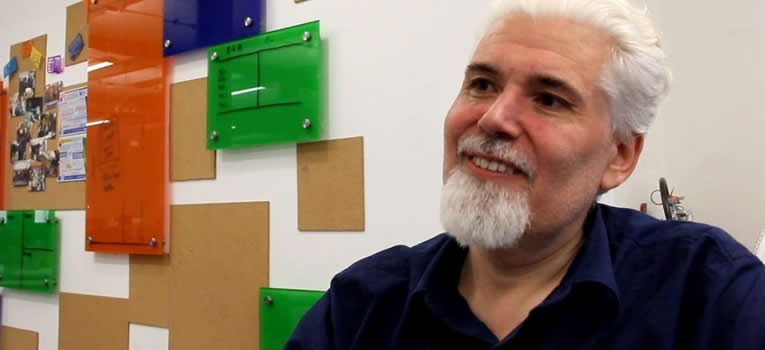
Dr. Joan González Guardiola, philosopher and specialist in phenomenology, also a scholar at the "Universidad de las Islas Baleares" in Palma de Mallorca, Spain; he has questioned the definition and function of money from a phenomenological perspective, meaning, from the set of manifestations or phenomena that characterize its process.
The professor visited the University of Guanajuato (UG) to give a three-day course called "Phenomenology of money" at the Department of Philosophy.
In the economy manuals, money is defined as every asset that serves as payment to generate exchange and become a unit of count and value. In an interview, Dr. González mentioned that money is not an object, but a "social relationship that reduces the contingency of encounters between production purchase. Money is presented as a re-organization of the space-market and there is also a temporarily essence because of what we call money there is a synthesis of time."
In that sense, the scholar highlighted that the relation between time and money is tight, since the latter is a symbolic representation of time –be that of time or debt— "we can exchange as an object".
Money doesn't exist if we don't think in lengths: work times, debt duration, production processes, etc. Dr. González used an example and said: "I can pay a debt in eight of my life, which in the investment purse in a bank is sold in a small packet as a thing, so eight years of my life and packaged."
This is how you can explain the temporal connection of money, "Marx said it, money tends to hide its origin and value, plus it has a projective nature, focuses on the future and not the past."
The researcher continued explaining: "If we make an exhaustive research on how the money is created, we will reach the conclusion that it is a mistake to think that money generates in the market independently from dysfunctional factors. The state has the monopoly of the coin and we use the money to have a relationship with the community."
That is how Dr. González spoke about the relationship money has with the political power and remembered the phrase of the Economy Nobel Award, Paul Samuelson: "It doesn't matter who dictates the laws of a nation, as long as I can read their economy manuals." He said that phrase was his inspiration to make a philosophical analysis about money, thanks to the words from Samuelson.
He said, "the processes of the constitution of money are processes linked to power, even to the political power, it is the state who mints a coin, coins are the monopoly of the state. The phenomenon of the link with the political power is not indirect, is direct. Some of the monetary functions are generated through the state's speech."
Dr. Joan González Guardiola, began to be interested by the ontological plan of money's theme because, such study object is always addressed by the economy and the monetary theory, the reason why the researcher decided to "introduce in the monetary theory, fundamental aspects that don't come from the economy but from philosophy."
In his article "Ontology and the functions of money. A phenomenological approximation", he mentions that "what is attractive of the ontological plan of money's theme is that, despite our comprehension that from this depend many eloquent things, it doesn't stop being something we coexist every day with."
He explains that the phenomenology of money must be instated by a change in where we look, "because otherwise, money continues being as a trivial and common object. It is difficult to find a day where we don't use it at all. Nevertheless, this closeness allows us to comprehend it."
With this research, analysis and reflection on the phenomenon of money, Dr. González Guardiola pretends to "conquer some the multiple labyrinths in which the nature of money is implied."
It is important to mention that Dr. Joan González Guardiola, is a philosophy professor at the University of Barcelona, where he teaches Theory of Knowledge, Social Philosophy and History of the Social and Political Systems. Also, he is a professor in the Master degree for the formation of the faculty, in the subject "Formation complements". In 2017, he published "Mercancía y Deuda. Aportación de una fenomenología del dinero a los fundamentos de la teoría monetaria" in the editorial Jitanjáfora, of UNAM (Mexico).
Photo Gallery