
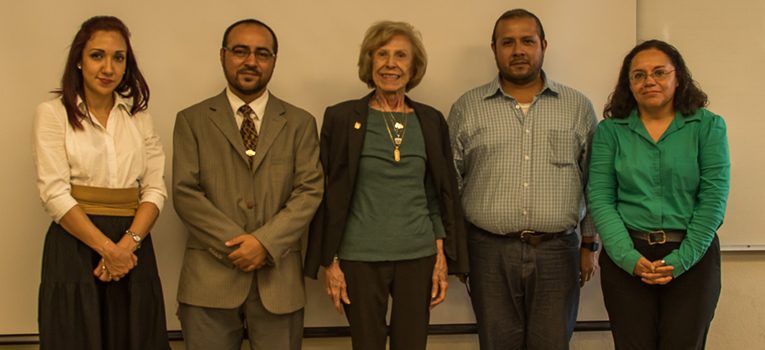
León, Gto., September 25, 2017.- With the purpose to strengthen the knowledge of the student community and provide both research and intervention tools that contribute on people having a better wellbeing, the third edition of the colloquium "Cultura, Ambiente, Bienestar" was held at the Department of Psychology of Campus León of the University of Guanajuato (UG).
The event was organized by the Academic Bodies "Basic processes of the Individual's development" and "Subject and Context", and the main theme was the concept of wellbeing, adding other topics such as happiness, sustainability and culture; the activities were conferences, workshops and movie cycles.
Dr. Fredi Everardo Correo Romero, professor-researcher of the Department of Psychology and member of the academic body "Subject and Context", mentioned the importance of having this space open for knowledge and addressing topics of interest. He mentioned that "liaisons are created between students of the Division of Health Sciences and the Division of Social Sciences and Humanities, also, with professors from other universities, and they seek the exchange of ideas and increase the participation."
He remarked that in past editions, they addressed the topics of culture and environment, and for this third option, the colloquium had the participation of outstanding researchers of Campus Leon from UG and scholars from other universities.
Such is the case of Dr. Isabel Reyes Lagunes, professor Emeritus of the Universidad Nacional Autónoma de México (UNAM), who gave the conference titled "La psicología del mexicano y su bienestar" where he made an analysis of the elements present in the environment that impact on the wellbeing of the people, their capability to adapt, and response to them.
Dr. Juan Carlos Manríquez Betanzos, from the University of Hermosillo, gave the conference "Felicidad y conducta pro ecológica: diversas consecuencias", where he addressed aspects of environmental psychology and positive psychology, and the factors the allow to potentialize wellbeing.
They also had the presence of scholars from the Universidad Iberoamericana de Puebla and the Universidad Autónoma de San Luis Potosí.