Irapuato, Gto., November 8, 2017.- Professors of the University of Guanajuato (UG) presented different sustainable agriculture projects during the VIII Interstate Fair of Water and Woods Culture of the Council of the Lerma Chapala Basin.
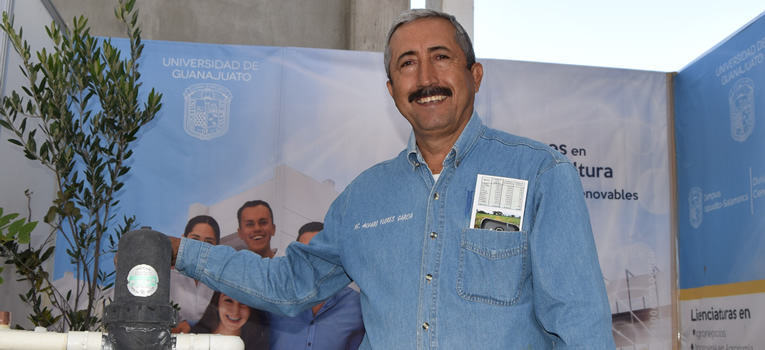
M. Álvaro Flores García, professor at the Division of Life Sciences (DICIVA) and expert in water technification, showed a prototype of a dripping system for the communities. This prototype is for the communities, because it allows to save 40% of the water and sensitize the producers regarding the efficient use of the vital liquid. The prototype has the parts of a commercial dripping systems, it is made of pipes and hoses so the producer can easily arm it, however, it does require some training.
Doctors Noé and Adriana Saldaña Robles, ascribed professors to the Department of Agricultural Engineering, presented a diagnosis of sanitary status of the Lerma river in the state of Guanajuato. This resulted on a mapping of all sources of superficial contamination. Thanks to geographical localization and GPS, multispectral aerial images they could detect the discharge zones of urban and rural wastewater, the industrial discharge zones, dump zones, as well as the wastewater of nearby towns.
The effect of arsenic in the barley crops was another study the Saldaña brothers shared in the event, this research was previously presented in the XII Agricultural Engineering Latin American and the Caribbean Congress.
Dr. Eduardo Salazar Solís, also a professor at DICIVA, presented the advantages of conservation agriculture, and informed that with the help of the students in the Agronomy Department, they have planted nearly ten thousand trees in different projects; since UG's venue Irapuato has a botanical garden where the tress grow a meter and a half or more to assure its survival. The researcher considered it is indispensable to reforest the surface in the peaks in Guanajuato, because there is only a 5% of the original forest surface, so this represents a great challenge.
Dr. Yann René Ramos Arroyo, professor at Campus Guanajuato, also participated in the event which gathered water users for the uses: aquaculture, agriculture, livestock, urban public and people interested in the preservation of the resources of the hydrological region.