
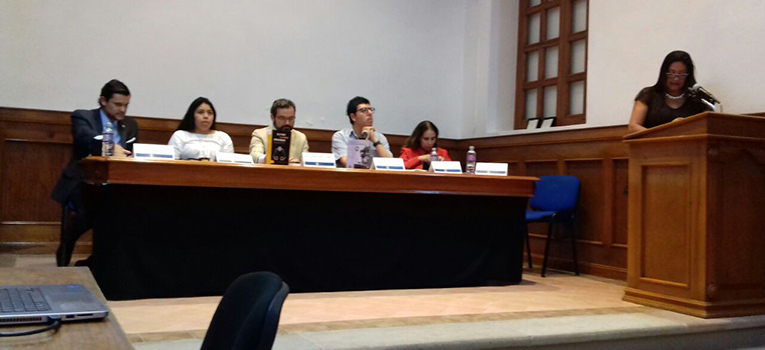
Guanajuato, Gto., November 11, 2017.- Hosted by the Academic Body "Buen Gobierno, Desempeño Institucional, Elecciones, Cultura y Comunicación Política" of the Division of Law, Politics and Government (DDPG), two books were presented in which, from a legal point of view but also social, address the case of the city of Cherán, Michocán.
The books are "De la "vieja" a la "nueva" justicia indígena. Transformaciones y Continuidades en las justicias indígenas de Michoacán del Dr. Orlando Aragón Andrade" and "Cherán K'eri. 5 años de autonomía."
At the presentation was present, Dr. Teresita de Jesús Rendón Huerta Barrera, Rector of Campus Guanajuato of the University of Guanajuato (UG), and commented on the text of. Dr. Eduardo Pérez Alonso, Director of the Division of Law, Politics and Government (DDPG); M. Ada Marina Lara Meza & Yunuen Torres Ascencio, member of the Council of youth in Cherán. As the moderator, Dr. María Aidé Hernández García.
There were also words from the author and from Dr. Guillermo Rafael Gómez Romo de Vivar, professor and researcher at the DDPG, who also remembered the electing experience in 2012 in Cherán and the current sui generis model, as well the political actors in that entity, in the search for democracy.
The book addresses the process through which the perception of justice was altered, he said, it has five chapters and makes a tour through research and the impact all moments have when they developed new figures, for example, the problems in the municipal courthouses, the details of the indigenous justice and the common trials.
It also talks about the international recognition of this movement, the expression of their fight that has gone beyond frontiers and engulfs once again all these ontological, social, legal aspects from which they have taken large examples.
They also present the question of how much was indigenous justice working, the way they composed the juries, how the integration of any other courthouse and it didn't guarantee the presence of indigenous people and, more than anything else, it seemed like surveillance.
In his comments, he agreed with Dr. Eduardo Pérez Alonso, that it is a book that writes new history, a point for analysis of the indigenous law, of its justice and procedures, a wide book and very interesting, well done, with care in the methodological parts, and a text based in the organization of the community of Cherán.
To finalize he quoted the phrase from "Tata Trini", an inhabitant of Cherán during his work in that entity: "Cherán is and always will be an example that courage transforms in bravery and organization."
Finally, the author, Dr. Orlando Aragón Andrade, thanked the University of Guanajuato and its authorities, the opportunity to present the text in this institution.
He referred that for seven years in the School of Law and Social Sciences at the Universidad Michoacana, and now in the Universidad Nacional Autónoma de México (UNAM) in an area of Social Sciences. Back then, there was a project that tried to rescue the social sciences and their relationship with law and legal studies, that sought to show the importance that social sciences could have to study law.
"This is a work of legal anthropology that basically centers in a field methodology, they are not seven years of research but working in situ, interview, history and, at the end, there is a research that tries to tell how, at first, a process such as the Legal Reform had an impact not only in the Supreme court of Justice but in the indigenous justice as well."
He remembered that in 2008 he started the research about the relationship of Law and Social Sciences when he "crossed", in 2011, with the Cherán process, when it was already in the last chapter of the thesis.
Then, he elaborated a study where it exposed that the anthropology, history, social sciences, have much more to give than just coffee talks, "works to litigate, to win trials."
Is a book that has given him many satisfactions, he accepted, and has had several national recognitions, "but everything is a product of the collective teaching, all this learning is condensed in making field and interdisciplinary research that doesn't exclude the world of Law", he said, at the same time cultivating the legal anthropology.