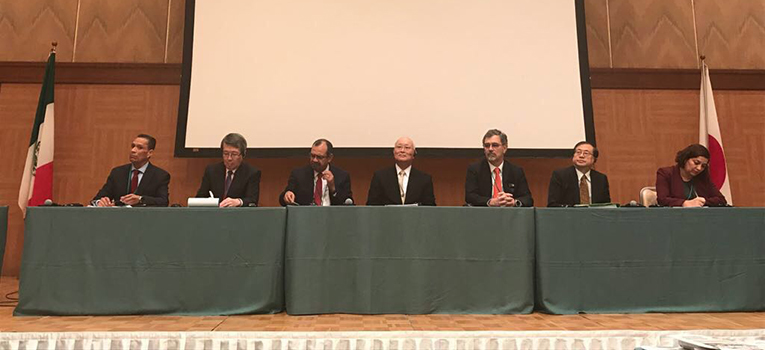
Hiroshima, Jap., December 1, 2017.- The University of Guanajuato (UG) maintains a tight relationship with 20 Japanese educational institutions, however, they foresee common objectives and multiple areas where they could intensify the cooperation, according the proposed by UG's President, Dr. Luis Felipe Guerrero Agripino in the panel "Colaboración Orientada para el Futuro."
The encounter was held in the Third Summit of Rectors Mexico-Japan, that gathers at the Hiroshima University approximately 60 rectors of institutions in both countries, in an event promoted also by the Mexican Agency of International Cooperation for the Development (Amexcid).
One of the main purposes in this Third Summit of Rectors México-Japan is to identify strategies of collaboration between the academy, the productive sector and the government, to encourage innovation and contribute to the solution of larger global problems.
In his talk called "Building bridges. Strengthening alliances for the equal and sustainable growth", Dr. Guerrero Agripino referred to the fruitful relationship between UG and 20 Japanese institutions, with which they have subscribed 37 collaboration agreements.
Added to the possibility of academic mobility between professors and students, as well as programs to train administrative personnel, UG has double degree programs with Nagaoka Technology University (Master and Doctorate in Chemistry) and Hiroshima University, (Doctorate in Mechanical Engineering). In addition, UG retook the model of the Japanese national colleges to create the Bivalent Baccalaureate in the High School College (CNMS).
The joint research projects also stand out in areas such as nanotechnology, water treatment, mechanics and mechatronics, architecture, environment, accounting and business, and quality control.
In his participation in the panel "Collaboration oriented for the future", UG's President also mentioned the solid relationship between Japan and the state of Guanajuato in the industrial sector.
With this background, Dr. Luis Felipe Guerrero Agripino sustained that the higher education institutions from both countries must lead actions to intensify the academic collaboration, and proposed to strengthen joint research in different areas of knowledge and increase the number of double degree programs, as well as the joint publications.
Also exhorted to widen the path for mutual understanding, in all social interaction spheres, beyond the classrooms and workspaces; meaning, between people, families and communities.