
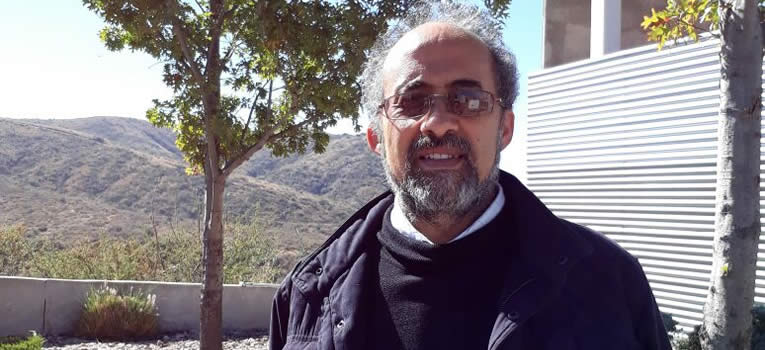
 Guanajuato, Gto., December 6, 2017.- The study of the soundscape has not been explored as much in out country, however, Dr. Ramón Alvarado Angulo, professor and researcher of the Department of Music of Campus Guanajuato of the University of Guanajuato (UG), males and effort on doing research particularly in the state capital.
For the specialist in soundscape and acoustic ecology, studying this area, allows to know and recognize the identity features of a specific place, particularly speaking about the topic of sounds that are produced in an hour of the day.
He explains it as, the soundscape, "are all those sounds around us, from the sound of the birds and pets, until machinery, vehicles and people (...) it can be urban or nature, the latter, is found on beaches, mountains, jungle, among other spaces."
"The way to preserve the soundscape is through recording, as if you were taking photographs, but you record, it is a non-stop fieldwork, I always reinforce it with video or photographs, they register with the same audio and it is archived."
He assures that the studies made in the city of Guanajuato have proven that it is a place that identity sound features, "because of its architecture, it gives the impression of being a Greek theatre, because of the shape of the drove way it has and how it has been constituted."
Alvarado Angulo shares that in Mexico, the topic hasn't been developed as much, only highlighting the works done by Félix Blume who, indeed has recorded, "he hasn't delved fully into the topic, at least not from the scientific point of view."
Likewise, he says, the National Sound Archive has a large collection of sound files, "but the activity stopped many years ago."
Studying the soundscape, he says, "is a way to preserve the cultural sound features, because the visual always prevails, the landscapers or photographers picture landscapes, but the soundscaper register sounds and archives them so at the time of consult, the sounds can tell us in what moment was recorded what we are hearing."
In that sense, it must be said that, being one of the few who studies the subject in the country, Dr. Ramón Alvarado has an archives of sound files he has been capturing throughout the years.
For the scholar, studying the soundscape of the city, "let's us know how Guanajuato was listened in another time, and there we can realize what sounds had very specific moments such as a popular party, the groups playing and their repertoire, the number of hours of for example the "novenario" made in a church, thanks to the sound archives we realize how these moments sound and this allows us to study the soundscape."
The previous, after pointing out that, for its own nature, the soundscape constantly changes, "but there are features that become an identity, for example, the bells of a church, some salesman in a market who's been there for many years, in the case of harbors, the sound of lighthouses, those sounds prevail."
Finally, he mentions that this area of study, can be a support for anthropological, ethnographic research, for social studies, psychological and many other kinds.