
León, Gto., December 25, 2017.- Optogenetics is one of the advances of medicine that pretends to revolutionize the treatment of some diseases and illnesses. The importance of optogenetics relies on that it combines genetics and optical methods to stimulate a specific group of neurons.
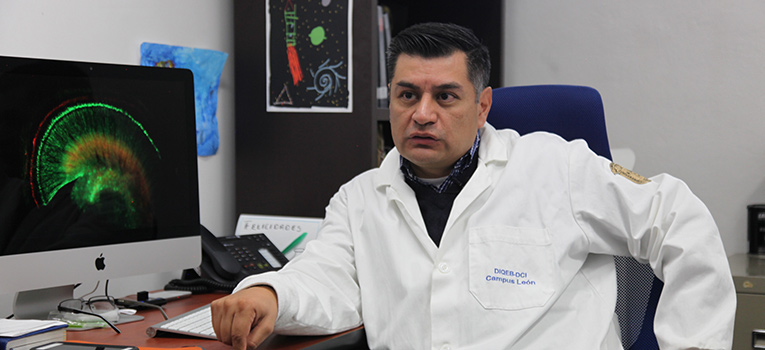
Dr. Victor Hugo Hernández González, the director and researcher of the Department of Chemical, Electronic and Biomedical Engineering of the Division of Sciences and Engineering of the University of Guanajuato, studies optogenetics; and in an interview explained that such technology mixes the knowledge of two disciplines and so, they apply light to specific tissues with the purpose to solve fundamental questions related with some diseases the human being suffers.
Optogenetics technology introduces proteins sensitive to the light in the cells to make them respond when they are stimulated with light.
Dr. Hernández commented that optogenetics has been used to solve blindness problems, as well as behavioral problems, since psychiatrists seek to counter neurological affections with this procedure. It has also been used in models with neurodegenerative diseases such as Parkinson, for physiotherapeutic applications and other alterations of the nervous system.
With the use of light, the scientists who bet on optogenetics have the objective if not to cure, to improve the quality of life of the patients with diverse pathologies.
Dr. Hernández has focused his studies on proving that optogenetics can be used to solve deafness problems. The researcher of the University of Guanajuato; by studying deaf mice who serve as models for human deafness, haven proven it is possible to activate in them the brain hearing canal by stimulating the internal ear with light; this is a great step on medical technology, because the quality of life of the patient might improve.
As an example, Dr. Hernández said that some people who are deaf receive cochlear implants and they works thanks to an electrode that stimulates the cells that stopped working, "the disadvantage of doing it with electricity is that they stimulate the desired cells, but also those who don't have to do with the problem, and frankly they don't want to stimulate, by doing it with electrodes it is inevitable for that to happen."
He continued saying that, "however, when we stimulate with light, we only do on the cell we want and that has helped for the stimulation to be much more specific, more controllable, and we think it is better for all the patients."
To make research in optogenetics, UG researchers have collaborated with other universities of the country and with the Optics Research Center (CIO), in addition of making teamwork with foreign universities, with the purpose to continue advancing in the development of this technology and generate more research lines, parting from this one.
Thanks to such collaborations, they published a chapter in a book edited by Cambridge University, where they address how optogenetics can be used to return hearing to deaf patients.