
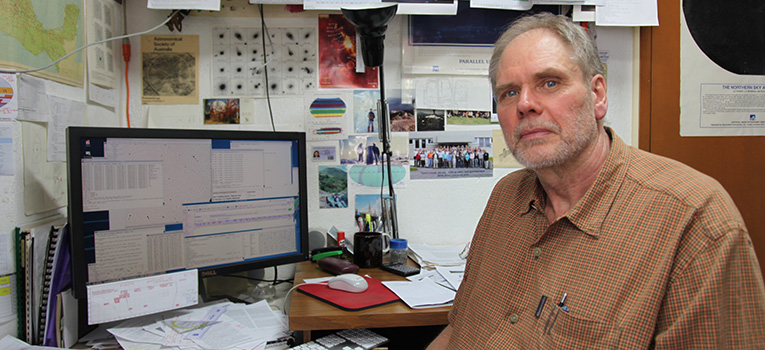
Guanajuato, Gto., December 24, 2017.- Over four decades ago, astronomers discovered the first example of a giant radio galaxy, but given the difficulty to detect them, the scientific literature only reports a small percentage of the ones that exist. Hence, the researcher of the University of Guanajuato (UG), Dr. Heinz Andernach develops a project to find more of this extreme size objects.
We talk about radio galaxies when they emit more radio waves than a normal galaxy, explains the German scholar, a professor at UG for 21 years.
In most of the radio galaxies, its radio waves extension exceeds by far the optical size of the galaxy. Dr. Andernach's project focuses on those that reach extreme sizes. They are called giant radio galaxies when they radio wave emission exceeds 3 million light years; this means that light would require this time to pass from part to another of its radio waves extension. The largest reported until now is almost 16 million light years, or three times larger than a typical size of a cumulus of galaxies.
"What is interesting of the ones we call giants is that their physical sizes extend by regions of the Universe who cover very different ambient, and we can use them as probes in the environment", mentions Dr. Andernach.
These objects can give us information about the conditions in its surroundings, in a space of millions of light years. "They tell us about the possible presence of cumulus or strands of galaxies, which would be difficult to see in large scale optical traces. However, the giant radio galaxies allow us to choose small zones in the sky where to seek these structures with a deeper optical study."
Recently, the researcher published reports of his findings with help from the students Jonatan Rentería Macario and Brissa Gómez Miller, who made a research internship with him (see http://www.arxiv.org/abs/1710.10731 & http://www.arxiv.org/abs/1710.11490).
The reports describe the discovery of seven new giant radio galaxies in two recent radio waves tracking, of public access and done by sensible radio telescopes. However, Dr. Andernach cleared that in the last years –with help from students and peers—they have gathered a sample of hundreds of these objects that quadruplicates what is spread in the literature."
The project began in 2012 during a Research Summer led by Dr. Andernach, in which two students participated, Erick Jiménez Andrade and Raúl Sánchez Maldonado, who for seven weeks, inspected about 3,500 images covering all the sky in radio waves. Because of their hard work, in just seven weeks they doubled the number of giant radio galaxies known.
"We have noted several objects that can overcome the one with the label of being the largest discovered until now, but we are missing some data to be sure", he explained. For now, we have been able to publish the discovery of the quasar with the largest radio extension see (http://adsabs.harvard.edu/abs/2017MNRAS.466.921C) with 14 million light years.
This convinced Dr. Andernach of the potential visual inspection has, so far, the automated algorithms only detect a small fraction of these objects, but the human bran can do it and note objects with unusual morphologies. "I keep betting on investing a good part of my time to visually inspect these images," he sustained.
Based on the previous, he exhorted to participate in the project of citizen science "Radio Galaxy Zoo", in which volunteers help the scientists to identify objects with a complex radio emission, because there aren't enough professional astronomers that can dedicate the necessary time to identify the called "host galaxy" that emits it (see http://iopscience.iop.org/article/10.3847/1538-3881/aa90b7/meta).
"Each one of you –with a small training—, can be capable of recognizing these suspicious patterns and seek for yourselves in available databases to find these host galaxies and publish your contributions", for which this site is open https://radio.galaxyzoo.org/
The volunteers who participate in these projects "contribute in a significant way and I feel that in the future, when we will be flooded of these data, we'll need even more the help from the aficionados", concluded the researcher.
Dr. Heinz Andernach works in various research related with radio astronomy, the structure in large scale of the universe, the distribution of the galaxies. He is part of the Department of Astronomy in the Division of Natural and Exact Sciences (DCNE) of Campus Guanajuato of UG.