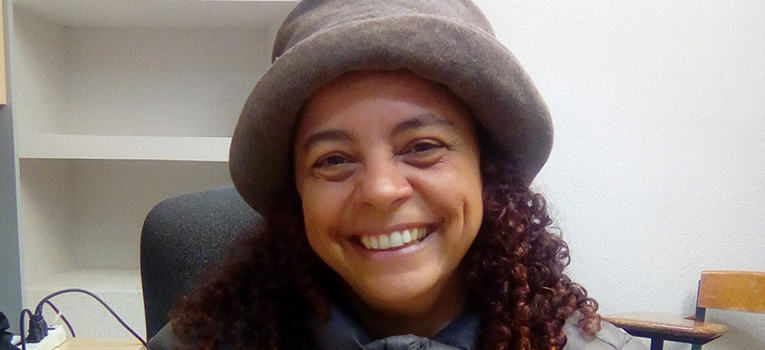
Guanajuato, Gto., February 6, 2018.- Dr. Elcia Margareth Souza Brito, a professor-researcher of the Division of Engineering (DI) of Campus Guanajuato, as well as a group of master's and Ph.D. students, have isolated and characterized new strains of bacteria with biotechnological interest and address contamination problems due to chrome and arsenic.
In an interview, the researcher explained that she has many postgraduate students who are interested in basic science, because she makes bacterial bioprospection with a biotechnological interest.
From this group of young scientists, she said, Maria Fernanda Pérez Bernal has received a Ph.D. by isolating a pseudomonal bacteria with industrial use; in May, another master's student isolated another specie; and she herself isolated another new specie from some tailings in the city of Xichú.
This work, she explained, answers a project in search of microorganisms, specially bacteria with biotechnological interest, which is made in coordination with educational institutions of France: Aix Marseille Université, Université Toulon, Mediterranean Institute of Oceanography, Marseille, France; and Université de Pau et des Pays de l'Adour, IBEAS, Pau, France.
This bio metals project has the support of the National Council of Science and Technology (CONACyT), in which the objective was to search technologies for the bio generation of metals and metalloids; to solve the problem in Guanajuato such as the chrome, and France's, which is arsenic, although finally, both metals are world environmental hazard.
Dr. Souza explained that she has worked this topic since 2008, when she entered the University of Guanajuato, and arsenic since 2003; however, is not easy to get resources for non-applied scientific research, meaning, basic science.
Nevertheless, she made a sabbatical in France to study the mine dumps of arsenic and negotiated the stay for three of her students in the project, among them Julio Valerdi, who defends his master's in the Université de Pau, characterizing his strain; and Fernanda Pérez Bernal of the Ph.D. in Marseille Université, because these institutions have the required laboratories.
Fernand Pérez obtained her degree for discovering a new strain in the alkaline crater lake of Parangueo, Valle de Santiago; said Dr. Souza, who in the same place, has isolated three new species of three species, one of them already deposited in banks of France, Germany and Japan, so they already published the article in an international taxonomy magazine, describing a new species of bacteria in Mexico: parangueonense.
She explained that it is about an interesting alkaliphile for future studies of transforming metals and search new extreme enzymes.
Within the same project, there is the thesis of Paola Martínez, mentioned the researcher; thesis not from the same lake, but from the industrial waste of the company "Química Central", and is bacteria that is highly resistant to hexavalent chrome.
Dr. Souza that it is also about a new specie, but the student will not describe this specie, but isolated it and studied the potential to use the strain for the transformation of chrome; and then another master's student will come to characterize it, so a lot of work ahead.
Identifying new species of extreme bacteria is not developed in Mexico, said sorry Dr. Souza, because is not applied science, "basic science per se, has no application; but is produced for future application", so she wishes there's more support for this work.