
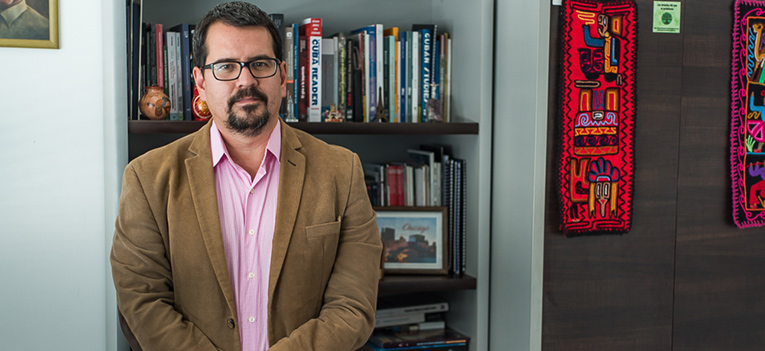
León, Gto., February 20, 2018.- With the participation of Dr. Armando Chaguaceda Noriega and Dr. Fernando Barrientos del Monte, both professor-researchers at the University of Guanajuato (UG), conducted the conversation "elections 2018 in Latin America. Scenarios and derivations from regional policy. "
The event took place in the Faculty of Law of the Universidad Autónoma de San Luis Potosí (UASLP), where the state of democracy in Latin America was analyzed, as well as the electoral processes that will be carried out in countries of the region during the present year and 2019.
Dr. Armando Chaguaceda and Dr. Fernando Barrientos shared views with specialist political scientists from UASLP and presented a balance of the political processes of the region and the possible scenarios because of the electoral processes that will occur in seven countries where the Presidency of the Republic, state governments and legislative spaces will be defined.
Dr. Armando Chaguaceda, a researcher in the Department of Public Management and development at the León de la UG Campus, commented in an interview the importance of these electoral processes in which not only political options will be chosen, he said: "We are at a decisive juncture in Latin America, defining many things; I believe that in Mexico this election will be very important, in fact because it can change the panorama, not only political party options but even political projects. "
He added that we must analyze the scenario from a global perspective, and generate spaces for debate with pluralism of ideas, with a diversity of criteria and based critique.
He also expressed the importance of citizen participation in electoral processes as it represents the opportunity to elect their rulers, exercise the right to vote and reassess democracy, "we can rotate the rulers and that implies that you can have every six, five years the ability to choose" he remarked.
In this sense he expressed the benefits that democracy provides because it represents the way to manifest itself in front of the governments and "the effect of the rotation of the charges by the way of the elections inhibits in the present negative behaviors because it can be sanctioned in the future. "
Finally, he commented on the role of education institutions and the mass media where "the discussion of ideas and the impact of public debate should be opened; I hope that universities will become more and more spaces for debate and intellectual production, and to train professionals prepared for complicated scenarios. "