 Guanajuato, Gto., February 22, 2018.- This Friday, February 23, at the 39 International Book Fair (FIL) of the mining Palace, will be presented the books "Ciudades y Centros Históricos" Volume I & II, texts that were coordinated by professors of the Division of Architecture, Art and Design (DAAD) of the Guanajuato Campus of the University of Guanajuato (UG).
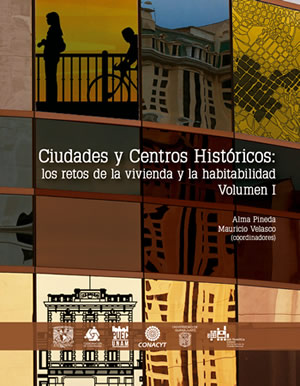
Dr. Teresita de Jesús Rendon Huerta Barrera, rector of the Guanajuato Campus, will participate in the presentation of the work that has prologue: "Ciudades y Centros Históricos: los retos de la vivienda y la habitabilidad. Volumen I", which was coordinated by Dr. Alma Pineda Almanza of the Department of Design and Dr. Mauricio Velazco, coordinator of the master's in urban and regional planning, both from DAAD.
It should be pointed out that, the books are the result of the work and reflections carried out in the "International seminar cities and historical centers, the challenges of housing and habitability", held at the architecture venue of UG and sponsored by the Conacyt thematic network on "Centros Históricos de Ciudades Mexicanas".
It's about the texts "Ciudades y Centros Históricos: los retos de la vivienda y la habitabilidad. Volumen I", and "Ciudades y Centros Históricos: habitación, políticas y oportunidades. Volumen II".
The first book is composed of several works carried out by researchers from different disciplines of the Conacyt thematic network on "Centros Históricos de Ciudades Mexicanas" and helps to clarify some realities in conservation issues in the transformation; heritage in times of the disposable and local culture in globalization.
"Los retos de la vivienda y la habitabilidad" argues that documentary work, planning, research and management in historical centers has ceased to refer to the conservation of heritage built as understood in the twentieth century as a commitment to sustainability and permanence of evidence Historical.
The concerns and problems that interest today, it is said, are much more complex and refer to a variety of elements that are identified as participants in the patrimonial areas, with characteristics of centrality, from the permanence of the materiality Historical, but they reach the imaginary of the original and floating populations.
With regard to volume II "habitación, políticas y oportunidades", the conservation issues of the built-up patrimony are not limited to the lamentation of the lost or to the extreme conservation of what remains; But the patrimonial city is understood as a current entity, whose characteristics make it complex, where it recognizes the adaptation that has preserved part of its material memory, allowing it to evolve the social memory.
In the foreword of Dr. Rendon Huerta Barrera to Volume I, the multidisciplinary character of the text, its object of boarding, as well as the high professional quality of those who coordinated and wrote it, are highlighted.
She highlights that one of the tangible results of the thematic network "Centros Históricos de Ciudades Mexicanas", supported by the National Council of Science and Technology and whose technical manager is the eminent urbanist, Dr. Alicia Ziccardi Contigiani, is just this publication that shows the continuous change of society and its effects on the identity of cities and their historical centers.
She highlights that the preservation of the historical centers, transited from a vision of the isolated monument, to a dimension of the urban complex, whose recovery and rehabilitation, is a matter not only of economic and social sustainability, but of identity of the peoples.
"Over time, environmental problems, violence and insecurity, unemployment, increased poverty and lack of social cohesion become more algid and complex, which ultimately result in the poor quality of life of citizens and a potential violation of their human rights," refers Dr. Rendon in her text.
She believes that in all this problem, it will be essential that the historical centers regain their social, cultural and urban function, as founding nuclei that harbor a great wealth of assets, as well as churches, shops, houses, green spaces Interconnected with urban helmets, transportation and public services.
Finally, he explains that the coordinators of this book, Dr. Alma Pineda Almanza and Mr. Mauricio Velasco Avalos, enjoy a wide recognition not only for their contributions in their disciplines, but also for the formation of new cadres of professionals from the arts, architecture, design and urbanism.
Photo gallery