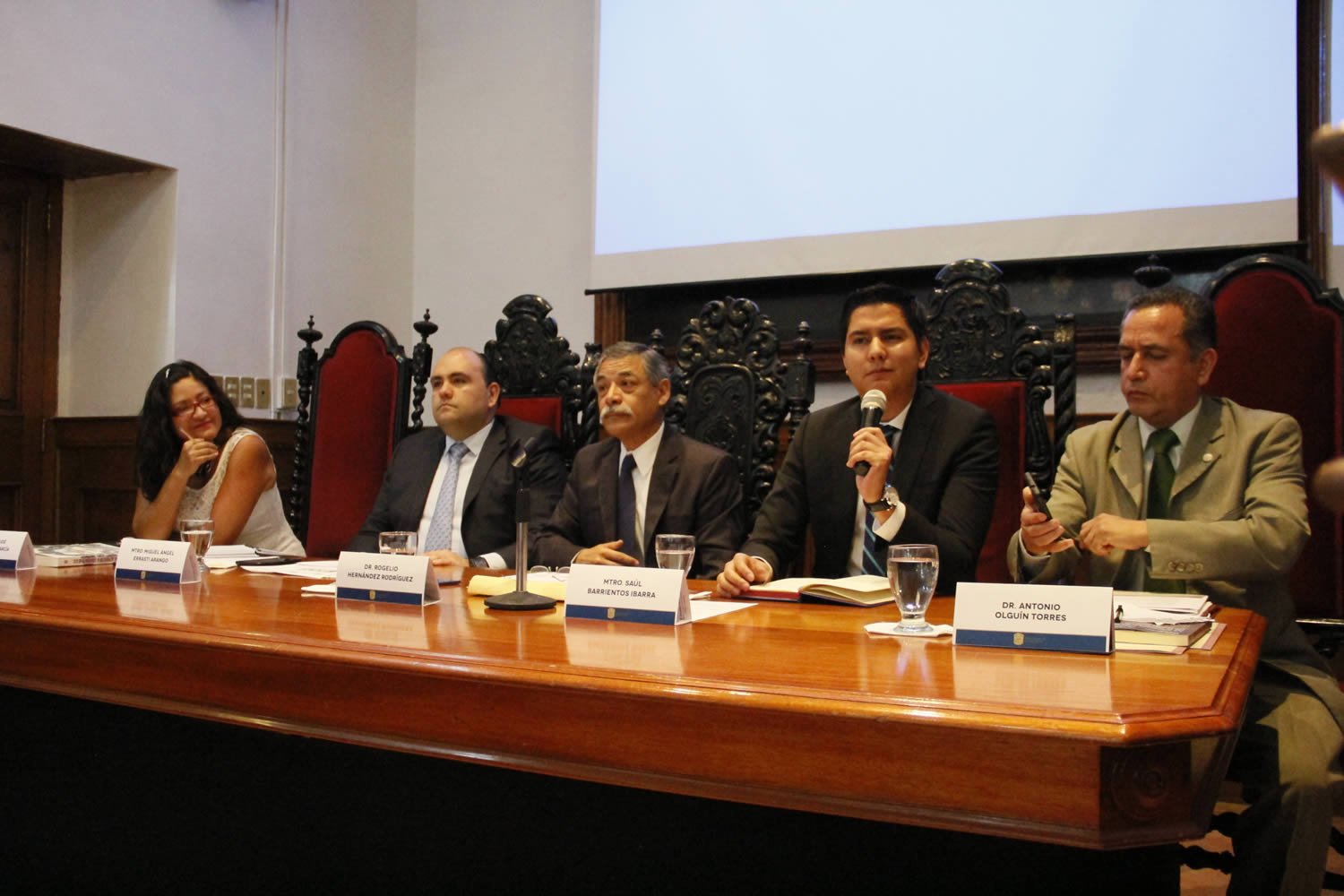
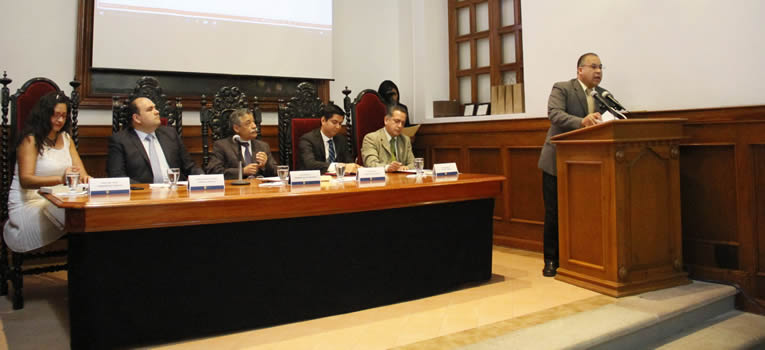
 Guanajuato, Gto., March 6, 2018.- With the purpose of fomenting the informed vote because the upcoming election day in which they play 1800 positions of popular election in the country, the University of Guanajuato (UG), through the division of Law, Politics and Government (DDPG), organized the panel " Political parties and presidential elections. "
Participated Dr. Rogelio Hernández Rodríguez, a professor-researcher at the Colegio de México; M. Miguel Ángel Errasti Arango, Director of the Parliamentary Research Institute of the Legislative Assembly of the Federal District; M. Saul Barrientos Ibarra, coordinator of the content Office of the PRI parliamentary group in the Chamber of Deputies; and Dr. Ma. Aidé Hernández García, a scholar of UG, who one of her lines of investigation is the analysis of the opposition in Mexico.
Dr. Rogelio Hernández announced that according to five surveys, --considered the most reliable--, during January and February of this year electoral preferences placed first Andres Manuel Lopez Obrador (Morena), followed by Ricardo Anaya (PAN-PRD), and in third place to José Antonio Meade (PRI).
However, he warned that these results should be taken with extreme caution by several factors. Among others, because the surveys are temporary expressions that basically demonstrate the degree of knowledge that citizens have of a character and AMLO, he said, has about 20 years in the campaign, which explains that he is the best known.
But in addition, the campaigns will begin until 30 March, and when that happens, significant changes can occur, because then it will be possible to expose proposals, debates and independent candidates to have more spaces to make known their proposals.
The Colmex researcher also noted that between 20 and 25 percent of respondents said they did not have a definite vote, and that percentage will determine who is the winner.
Another factor that must be considered in these elections is that the hard vote of the parties has declined greatly, and the degree of abstentionism is around 50%, added Dr. Rogelio Hernández.
"There is no policy without pragmatism," and the parties are being too pragmatic, as the alliances between parties with different programs and ideologies demonstrate.
Coincided at this point the M. Saul Barrientos Ibarra, coordinator of the content Office of the PRI parliamentary group in the Chamber of Deputies, who argued that the parties are now rather associations of politicians, and ideologies are being left aside.
He highlighted in his presentation the weight that voters will have between 18 and 40 years, because they represent more than 50 percent of the voter registry. In addition, he listed some of the characteristics of the upcoming elections, among which for the first time three debates will be contending independent candidates and where there has not been a real exchange of ideas, because the news is what monopolizes the attention.
Therefore, he promoted a more rational and less emotional vote. An alternative to raising the level of the debate raised, is that the candidates can disseminate achievements, and therefore that there is the possibility of discussing them.
In his speech, M. Miguel Ángel Errasti Arango, Director of the Parliamentary Research Institute of the Legislative Assembly of the Federal district emphasized that the only way to access the transformation of things is through political parties, hence the importance of voting.
In his opinion, in Mexico there are too many obstacles to vote, which makes it a more expensive process, in addition to discourages the citizens to go to the polls. A fundamental point, given the high degree of abstentionism.
Dr. Ma. Aidé Hernández García, professor of the UG, focused her analysis on the case of Morena, a party that, she said, is very young and lacks a strong structure.
In the opinion of the academic, the country suffers the "fear" campaigns because it discourages the vote and questioned what would happen if the Mexican makes a differentiated vote.
The panel at the UG was carried out by student initiative, with the aim of promoting dialogue in an academic, nonpartisan and respectful environment.
The inaugural message was overseen by UG's Attorney General, M. Alejandro Murillo de la Rosa, representing UG's President, Dr. Luis Felipe Guerrero Agripino, who mentioned that the topic addressed is transcendent and these exercises motivate the reflection, while providing elements to go to vote in an informed way.
It was the turn of the Director of the DDPG, Dr. Eduardo Pérez Alonso, to welcome the participants. He agreed with the importance of the matter in question because it has to do with the political future of the country.
Photo gallery