 León, Gto a March 14, 2018.- As part of the activities of the 2018 International Brain Week held in the venue Forum of Campus León of the University of Guanajuato (UG), Dr. Silvia Solis Ortíz, a researcher at the Department of Medical Sciences gave a conference tilted "The memory of a dancer" where she explained the brain processes to correctly execute the movements and how the memory works to allow a dance to move artistically, as well as the benefits of dancing.
Dr. Solís talked about the interest of the scientific community to address topics related with cognitive neuroscience where they seek to know how the movements are represented in cognitive levels and how this mental representation is linked to the control of movement and learning.
For a dancer to artistically and technically execute the movements there is a complex process in which the auditive, visual and motor memory are linked. "Dance is a complex activity where the brain is taken to the extreme because for it to execute a movement, the muscle must've learned it, so it begins through small traces of memory that widen and are kept in the muscle memory and especially the brain" she said.
Also, she expressed the capability the brain has, to store and discard information as well as the way that possibility increases through training. In this movement learning process, she explained that the declarative and non-declarative memory act together to build the individual motor repertoire in which the hippocampus is the key brain structure for the memory and movement in space, which makes it easy to musicalize the movement, a stage that integrates the information of sounds to the rest of the senses to fulfill the artistic part perceived through the body and the emotions.
The ninth edition of the International Brain Week had the participation of Dr. Rodolfo Solís Vivanco, a neuropsychologist from the Institute of Neurology and Neurosurgery "Manuel Velasco Suárez", who offered the conference "Memory disorders in the neurodegeneration" where he mentioned the basic features of memory through the biological and cognitive point of view focused on two main illnesses, Alzheimer and Parkinson.
He remarked that learning something new, like a language or play a musical instrument independently of the age, every time gets better and better to protect degenerative diseases, just as doing exercise regularly and have a balanced diet allows a healthy state of mind.
He said, "recently there is a very interesting fact of the value it has not to lose social contact, maintain relationships and friendships during adulthood and elderhood, based on affection, it also has a protecting effect against neurodegeneration."
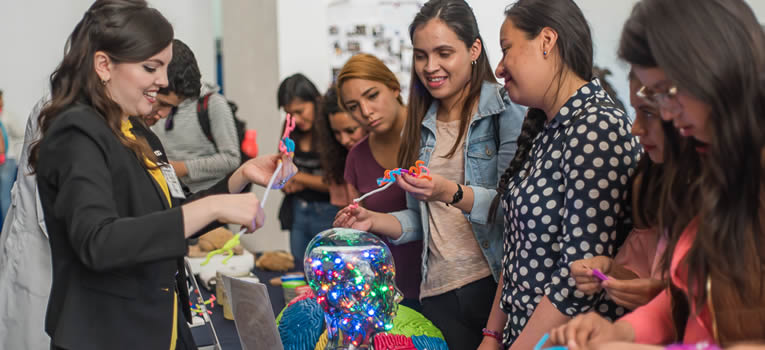
The activities will continue March 15 and 16 with the presentation of conferences, the projection of a movie related with the subject; plus, the attendees, will be able to appreciate the expo of brains, posters, and visit stands to receive information about food that are good for health and topics related with the brain functioning.
The event's inauguration ceremony was held by Dr. Carlos Hidalgo Valadez, Rector of UG's Campus León who thanked the efforts made by the organizers and who participate in this edition that for the second time, it extends its activities to the venue Mutualismo of Campus Celaya-Salvatierra.
Photo gallery