
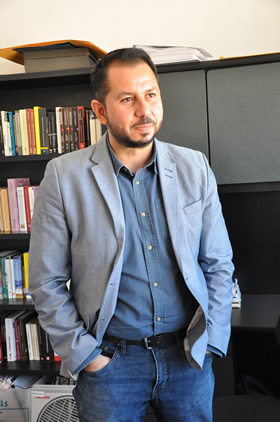
 Guanajuato, Gto., April 1, 2018.- Despite there is a general idea that the XIX century in Mexico was a period of chaos and political turbulence, where elections were a simulation; this is a myth, there are studies that prove the level of citizen participation during the electoral processes, assures the historian Carlos Armando Preciado de Alba, a scholar of the University of Guanajuato (UG).
So, he mentioned that in the XIX c. we can find some incipient forms of what now the electoral campaigns are, where the role of the press was very important in the organization of the vote, diffusion and the creation of a public opinion.
The electoral practices are not a new phenomenon, they are part of a process that have to do with the search of more democratic forms, sustains Preciado de Alba, Ph.D. in History and ascribed professor to the Department of History, in the Division of Social Sciences and Humanities of Campus Guanajuato.
While he was researching the elites in the XIX c. for his doctoral thesis, the scholar began to study the legislative spaces and the dynamics in which they generated, which led to analyze the electoral processes. Currently, his research line is the political representation and the electoral practices in the XIX Mexico.
He explained that, different from the current elections which are direct, in the XIX c. were indirect, held in three stages, --or even four—. It wasn't until the Federal Constitution of 1857, that direct elections began to choose functionaries in certain levels of government, such as the governors of some states.
From the beginning of the XIX c., the elections were made from small jurisdictions, called parish (a form of organization of the population that didn't have to do with religious matters), who won in a parish was called primary elect, then they voted for a secondary elector, and they at the same time for their functionaries. "It was a disintegrated vote, but still a form of participation of the population".
Historical studies have proven that in those processes were involved people who were not necessarily part of the elites. Besides, the elections were constant, for city halls were annual, and they voted for mayors (there were city halls that had several mayors, depending of the quantity of the population), syndicates and reagents.
"So, it was a much more common practice than we thought", assures Dr. Preciado de Alba, who also mentioned that in the eve of many electoral processes they created newspapers to support a specific candidate, or to attack adversaries. "Sometimes those attacks pass to the ambience of rhetoric and they document the violent facts such as burning print houses or newspapers; or repressions in support events for a candidate", detailed professor of the Department of History.
An important element was the surge of electoral clubs, explained the researcher, who reminded that in the XIX c. there were no political parties, "there were factions, but not a party institutional structure as such."
Analyzing the political clubs lets know how the elections were organized and how the political platforms were divulged. They used to be led by intellectuals, but parting from the lists of the members, it is known that not everyone was a member of the elite. "We could say that there was also presence of the middle class and even found mobilization of popular classes, workers, farmers, artisans", affirmed Dr. Preciado de Alba.
He added that an element that contributes important information is the correspondence, since it allows to know how the candidates or leaders of the clubs talked about their mobilization strategies and mechanisms to divulge their political platform, but also how they would fill the ballots on the voting day or how they would defend the vote. "Because there were clear samples of frauds in those electoral spaces."
The electoral process goes beyond the election day. Sometimes for the historian is not so relevant who won, but what dynamics and strategies led to the candidate's triumph.
The organization and mobilization of the vote in the XIX c. is the topic of a project in which the UG scholar is working now, he emphasized that the idea of these works is to reach wider audiences and sensitize the new generations about the need and importance of the electoral participation.
Dr. Carlos Armando Preciado de Alba is a professor-researcher at UG, National Research Award Wigberto Jiménez Moreno (2009), member of the National Researchers System and the Network of studies on electoral practices in the XIX c.
He has multiple publications related with electoral processes, and legislative structures, electoral violence and political class in the XIX c.
Photo gallery