 León, Gto., April 17, 2018.- The common interest of research of the Institution of Population Ageing from Oxford University and the University of Guanajuato (UG) in the rise of life expectancy of the population and the problems elders face, originated a Letter of Understanding between the universities to strengthen the academic collaboration.
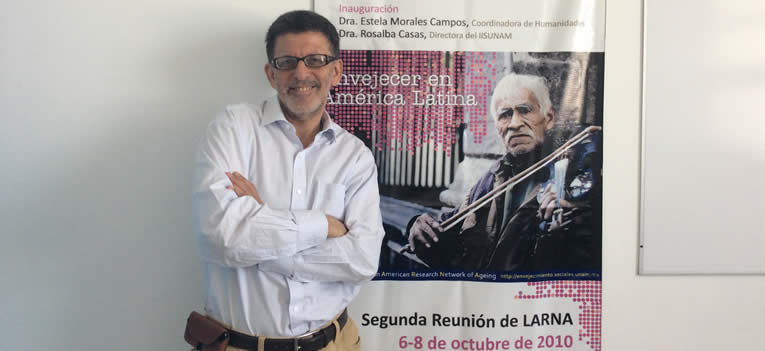
The Director of the Department of Public Management and Development of Campus León, Dr. Alejandro Klein Caballero, who is also an associate professor in the Institute of Population Ageing, mentioned that the Letter of Understanding eases the academic visits of students and professors, the incorporation of these research lines to the postgraduate level in UG, and the development of joint projects.
"As far as I know, we are the only university in Latin America to have a Letter of Understanding with the Institute and Oxford University, which I think is a very important award for the University of Guanajuato", said Dr. Klein.
As part of this collaboration with Oxford University, recently, Dr. George Leeson, Director of the Oxford Institute of Population Ageing, gave in Campus León the seminar "Who wants to live forever?" where students and professors from the Division of Social Sciences and Humanities participated.
About the addressed topics, he explained that global survival rate is bigger every day. "Is what I call the passage from imminent death to delayed death, meaning, 50 years ago, a 70yr old man had the idea that he was close to death. Today, a man that age doesn't have to think in that."
He even revealed that between third age people, the percentage that is rising is the centennials, hence the question, who wants to live forever? Because it is likely that for the years 2030 to 2050, a baby who is born in that time will have a life expectancy between 120-130 years.
"This life expectancy was not expected, same as most of the social processes, this implies we have to rethink everything again", sustained the researcher.
At an academic level, this topic is called "ageing society", nevertheless, Dr. Klein emphasized that it is not a theoretical matter, but an every day reality, that implies a radical remodeling of the traditional concept of family.
In this sense, he affirmed that this model is anachronic and needs to change because the replacement rate is 2.3, "it means, those who die are replaced if families have 2.3 children, but they are having 1.8, and that number keeps dropping". Consequently, if couples only have one child, at least three figures will disappear: the brother, the nephew and the uncle, "in a few years they'll be remembered in stories and movies."
This hypothesis says that the only child would have the attention of both parents, and for the first time in the history of mankind, he or she would have the four grandparents alive, in good health, competing for the attention of their only grandson. In his opinion, this will derive in an exacerbated narcissism, how are those overprotected people going to be? How will they face problems, frustrations, how will they deal with reality and be independent? he questioned.
Dr. Alejandro Klein, who also coordinates the Latin American Research Network of Ageing (LARNA) revealed that next November, at UG, the fourth workshop of this network will be held, in it, they'll analyze these topics. The workshop is open for all audiences and they expect the presence of scholars, government organisms and representatives of different social groups.