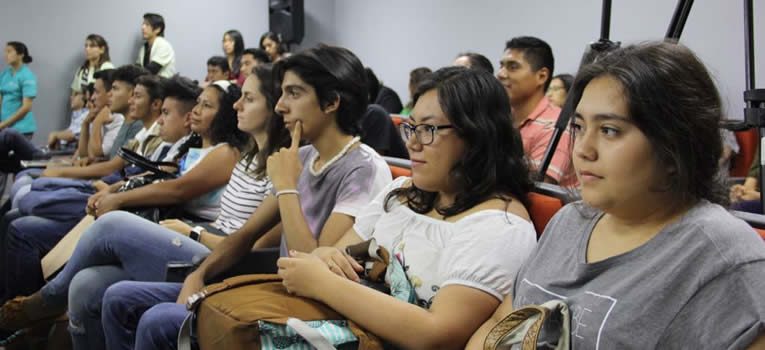
 Celaya, Gto., May 30, 2018.- The Campus Celaya-Salvatierra of the University of Guanajuato (UG) gathered the student community, professors and researchers to carry out the forum called "Transitando hacia la cuarta hélice" (Transitioning to the fourth helix), an event that emphasizes the importance of the liaison between the university, the government, the business sector and society.
In the forum's opening, the President of the University of Guanajuato, Dr. Luis Felipe Guerrero Agripino mentioned that linking is an indispensable tool for the growth and development of the university because this is how we show the social commitment we have with the local, national and global environment.
The President limited in the influence of generating knowledge because that builds a university, but also in the importance of democratizing it. For this, he explained that it requires to generate a diagnosis of the social needs and be sensitive of these with the purpose of joining forces and link the university community with entrepreneur and innovation projects with a humanist focus.
Dr. Graciela Ma. de la Luz Ruiz Aguilar, rector of Campus Celaya-Salvatierra, mentioned that the campus has 100 professors-researchers that form twelve academic bodies who have generated twenty research lines. In addition, there has been collaboration with different countries of Latin America and with United States, they have published books, indexed journals and developed patents.
The rector said that the forum is a space where the twelve academic bodies will gather with the purpose to talk and generate a direct link between the government, the business sector and society.
The professor-researcher, Dr. Ricardo Contreras Soto spoke about the publications he's developed regarding the perspective, experiences and prospective in the Laja-Bajío region of Guanajuato and presented a part of an audiovisual project that narrates the beginning of the phenomenon of the world caused by the raise in the population that causes the nearby cities to get closer and analyzes this phenomenon in Guanajuato to prove the process of legal formalization.
Another aspect shown in this audiovisual project is the phenomenon in such region and how the research process was made from which the data obtained allow to define lines of action and public policies to encourage a joint progress.
Likewise, Dr. Nicolás Padilla, a professor-researcher of Campus Celaya-Salvatierra, spoke about the link the Division of Health Sciences and Engineering has with the social sector, that generates knowledge, but also has the commitment of divulging and applying it, such is the case of three patents that they have generated: the osseous radar, the vein viewer and the electroacoustic probe.
Photo gallery