
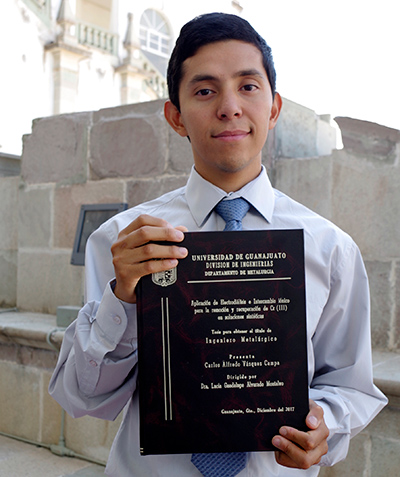
 Guanajuato, Gto., June 8, 2018.- Carlos Alfredo Vázquez, a graduate of the University of Guanajuato (UG), obtained the first place in the competition of electrochemistry thesis bachelor's level, given by the Mexican Society of Electrochemistry S.C., a proposal that he defended in December 2017.
The graduate of the degree of engineering in metallurgy, Eng. Carlos Alfredo Vázquez, obtained this merit with his thesis entitled "Application of chromium 3 in synthetic solutions for chromium solution".
In an interview he said that this award represents the validation of his constant effort, and emphasized the importance of this research. He also thanked the support of his advisor, Dr. Lucía Alvarado, who supported him throughout the work process.
His research covers the pollutants generated by the leather tanning industry, which allows to eliminate from 90 to 96 percent chromium from waste with various removal techniques, plus the removed chromium can be re-used to treat the leather.
Industrial waste is an important problem, especially in places like the city of León, which is characterized as a municipality with a strong presence of leather tanners.
These companies generate waste, including a metal, chromium. Most industries handle trivalent chromium (chromium 3) that is not so toxic, but if it is oxidized it becomes chromium hexavalent (chromium 6), which damages health and can cause cancer, commented Eng. Alfredo Vázquez.
He added that his thesis focuses on the treating these contaminants, with synthetic solutions to remove different amounts of chromium from three experimental techniques.
The first is the use of electrodialysis, through a small reactor and membranes to remove the chromium from the solution, which allows the removal of 90 percent of this element. The other two techniques are ion exchange and electro-ionization, with a removal of around 96 percent.
Eng. Alfredo Vázquez assures that there still is a long way to go, so he will carry out his master's degree in electrochemistry to follow up this research and in the future be able to cover the removal of other pollutants.