
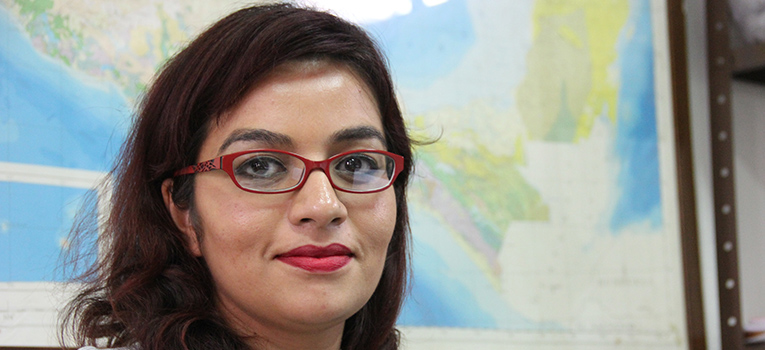
Guanajuato, Gto., June 13, 2018.- The eruptions of the "Volcán de Fuego", located in Guatemala, has left more than 100 death and approximately 200 missing people. The volcano is usually active, but it didn't have any strong eruptions, hence, the people felt comnfortable, explained Dr. Pooja Vinod Kshirsagar, a researcher of the University of Guanajuato (UG) and expert in volcanology.
The academy mentioned that the "Volcán de Fuego" is part of a compound where we can find the volcano as well of Acatenango and the Pico Mayor of Acatenango in that country. In the case of the "Volcán de Fuego" –active since last year—, the problem is that there is not enough monitoring, there is only one seismometer.
"This type of phenomena can be predicted with enough time, there is a lot progress in volcanology, geochemical methods, geophysical methods, geodesy, satellite maps to study a volcano and predict its reactions", detailed Dr. Vinod Kshirsagar.
The "Volcán de Fuego" is a stratovolcano, which means, it has periodic and explosive eruptions. To explain this, Dr. Pooja Vinod compared it with a bottle of soda, "when you open the bottle a lot of gas come out, but when the gas is agitated, it erupts". In this case, it mainly throws pyroclastic flows and ashes.
To measure the dangerousness of the pyroclastic flows, the volcanologist exposed that these contain clasts, meaning, fragments of rocks that can be small or even the size of a building. The clasts can reach temperatures of 700°C and high speeds. "They are very turbulent, and due to their high temperature, they tend to destroy and scorch everything in its path at the same time."
The researcher warned that the damaged caused by the pyroclastic flows is immediate, but the "Volcán de Fuego" also threw ashes. These disperse in different directions, depending on the wind. That is how they reached nearby cities to the volcano, like Acatenango.
The ashes pollute the air, water, crops. Also, it has fine particle that damage people's lungs who breath them. They are so dense, and accumulate in such quantity, that can even cause the roofs to collapse, affirmed Dr. Kshirsagar.
In Guatemala, the risk continues, because besides the ashes and the pyroclastic flows, lahars could form. On the matter, she explained that in volcanos this high –3,800m—there is usually a snow layer on the top. In rain season, if there is an eruption, the pyroclastic flow mixes with water or the snow to form the lahars, which are like turbulent flow that cause floods, "it's pure high temperature mud, so it can burn houses and everything in its path."
For now, it is not possible to know how much time the Volcán de Fuego will remain active, that depends on the amount of magma (melted rock underneath the crater) it has. That would have been known if it had been monitored, and now it can't be done, because the equipment would be destroyed.
For this reason, she emphasized that Guatemala has risks because of the activities of other volcanoes such as the Atitlán and the Pacaya, that are also active and tend to have this type of explosions. The alternative –she thinks—would be to have collaborations with other countries so they can aid with the monitoring.
This is important, specially because the tendency to form human settlements in zones close to the volcanoes, which explains why the terrain is quite fertile due to the high concentration of minerals in the soil.
Besides the monitoring systems, it is necessary to make people that live close to the volcanoes, aware of the risks they have of living there and what to do in case of an eruption. In Latin America there still is a lot of information missing about it, and in Mexico doesn't have good information for those cases either, warned the volcanologist.
To finalize, she spoke about the panorama in Mexico, and mentioned that there are two volcanoes considered dangerous: Popocatépetl and Colima. The first is monitored daily "there are cameras, spectrometers to determine the gases, its composition, its quantity. We have a network of high-bandwidth and low-bandwidth seismographs; there are geodesies, 4 GPS monitoring the inflation, each deformation of the volcano. So, in the case of the Popo, we can predict weeks before if there would be a fatal eruption, but in the case of the Colima, we still don't have this, they are barely beginning with this kind of monitoring", and good systems requires supervisions for years.