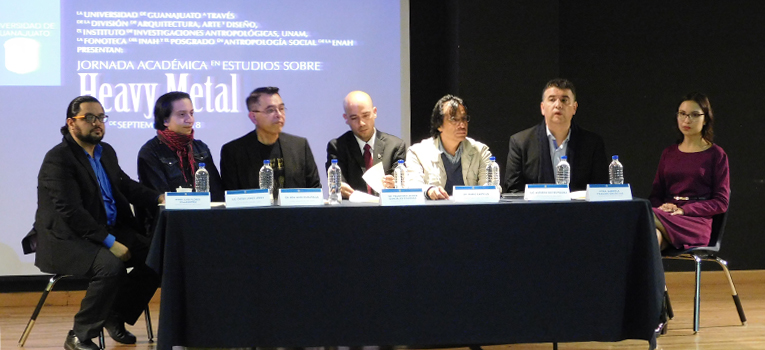
Guanajuato, Gto., September 24, 2018.- At the Arts Building, Marfil venue of Campus Guanajuato of the University of Guanajuato, took place the Academic Day in Studies on Heavy Metal, coordinated by M. Gabriela Fragoso Gradillas.
This academic meeting included the presence of 40 speakers in seven working tables with the themes: Guanajuato and its heavy metal scene, theoretical and methodological frameworks for the study of heavy metal, analysis and research of the sub-genre of metal, cultural practices body and dance, economy and cultural industries, migration and globalization processes and cognition and behavior processes.
In the same way, three lectures were given and the book "Musical Transhumance and Globalization" was presented. The metal has no boundaries, "by Dr. Oliva Domínguez Prieto, from the National School of Anthropology and History (ENAH).
This was commented by Dr. Francisco Javier González Compean, Director of the Division of Architecture, Art and Design (DAAD) of Campus Guanajuato, during the inauguration ceremony of this academic meeting.
M. Luis Flores Villagómez, Director of the Department of Music and Performing arts at the Guanajuato Campus, welcomed these days and have these activities at the University of Guanajuato, because they open the perspective to students, especially In the field of research and grateful for the support of the National Institute of Anthropology and History (INAH), the National School of Anthropology and History (ENAH) and the National Autonomous University of Mexico (UNAM).
In the same way, Lic. Alfredo Nieves Molina, General Coordinator of the Permanent Seminar in studies on Heavy Metal of the Institute of Anthropological Research of UNAM, celebrated the realization of this day, and thanked the speakers of all the Mexican republic, Guatemala and Colombia for their participation, because the intention was to create a dialogue and learn from each other.
Dr. Benjamin Muratalla, deputy director of INAH's Fonoteca (Sound archive), revealed that this institution is dedicated to the research, recording and dissemination of traditional and popular music, since everything is transformed: life, culture and, many anthropologists, for a long time they closed their eyes to new forms of culture.
In the case of music, he said, as human expression and part of cultural diversity, it is a pleasure to celebrate events such as these days, but also expressed his desire to not institutionalize this heavy metal movement because it would change its essence.
He recalled that in the 60 's there was a utopia to change the world to deviate from the dominant models and look for new ways of making life, but has noticed at times, in the papers of the ironworkers, an eagerness for social recognition. Perhaps, he said, the concept of subversion and alternative lives has changed.
The event was also attended by Lic. Diego López, in charge of dissemination of INAH's Sound Archive and Dr. Mario Castillo Hernández, Academic Secretary of the Institute of Anthropological Research of UNAM, who concluded that a space for exchange of ideas and experiences on this new musical genre, from an academic point of view.
Photo gallery