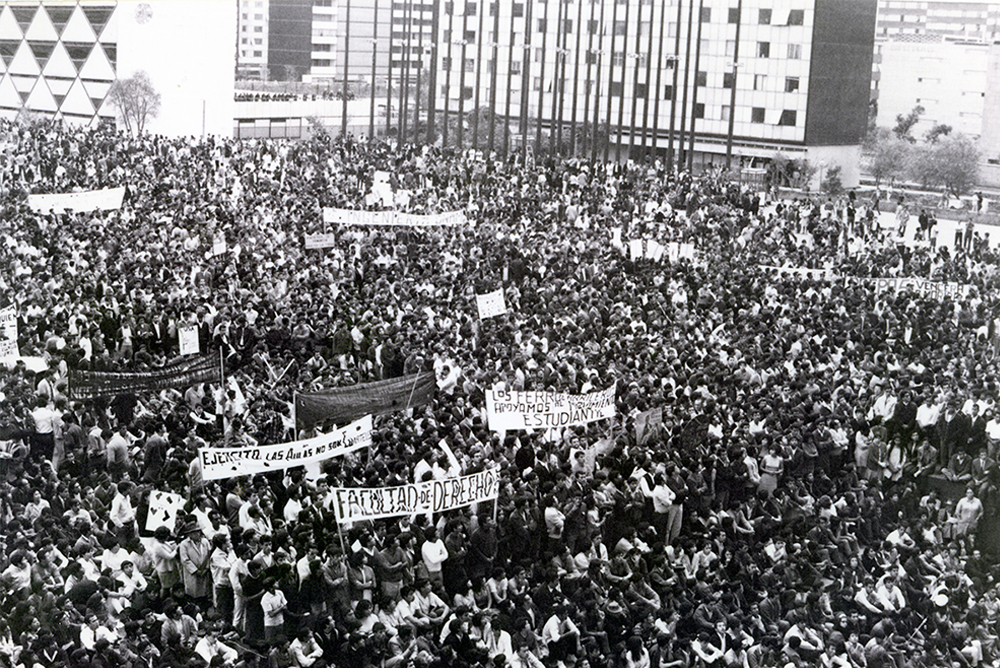

Recuerdo, recordamos.
Ésta es nuestra manera de ayudar a que amanezca
sobre tantas conciencias mancilladas,
sobre un texto iracundo sobre una reja abierta,
sobre el rostro amparado tras la máscara.
Recuerdo, recordamos
hasta que la justicia se siente entre nosotros.
--Rosario Castellanos
Guanajuato, Gto., October 2, 2018.- The request that students made in the 68 movement, contained three fundamental axes: "Freedom to manifest, freedom to dissent, and freedom to criticize power." At 50 years of the student movement there is still a lot of work to be done to defend the country's democratic freedoms.
The research professor at the Department of Philosophy of the University of Guanajuato, Dr. Aureliano Ortega Esquivel, who participated in this historical movement mentioned that the 68 served as a channel of expression to indicate serious problems regarding the politics and economy of Mexico and it was the students who represented the oppressed classes and fought against the repression of the Mexican state.
After half a century, the situation in the country is not far from violence, corruption and impunity, however the student movement was the impulse to generate a space of expression and critical thought directed towards the construction of a State of Law. José Revueltas –renowned Mexican writer—who actively participated in the movement referred to the 68 as the "beginning, by the youth of the disengagement process that will give the country a real story for the first time." In this regard, Dr. Ortega Esquivel said that the demand for public dialogue with the State was one of the principles to put aside the alienation and get involved in the foundation of a free and democratic society.
He stressed that the student community decided to engage in public dialogue with the state despite the direct repression that existed at the time "the solution of the State to the social problems was repression or corruption, that is why the demand for public dialogue has a deep sense as the students had nothing to hide from the defense for the freedom to say things, to encourage critical thinking."
"At 50 years of the movement, the state remains reluctant to dialogue publicly with its antagonists and repression and corruption continue to be used that do not give a democratic or constructive cause to problems, we currently have the case of Ayotzinapa." Here is the quotation of Octavio Paz, in which he noted that "Students sought public dialogue with power and power responded with violence that silenced all voices." In 1968 as well as what happened 4 years ago in Ayotzinapa are an example that the state is not yet prepared to curb violence and exercise the right to democratic freedoms.
Joseph Revolts wrote about that great historical mistake of 68 by the state "youth wants – and we want with it, those to whom it accepts at their side-a fundamental, essential transformation of political, social, economic and humanities policies of Mexico. The regime, on the other hand, has only wanted and has only proposed to corrupt and demoralize the youth, to make it in its image and likeness."
However, Dr. Aureliano Ortega said that the 1968 movement was the way to open possibilities of greater pressure on the part of its critics to the state and that there is now greater freedom of the press, also due to external causes such as the development of technology with Internet.
In a text about the 50th anniversary of 1968, the writer Guadalupe Nettel recalls that we also owe this student movement and those who lost their lives defending fundamental rights, "Democratic alternation, equal marriage and Legalization of abortion in Mexico City. The current wave of feminism and LGBT struggle, the interest in identities and ethnic minorities, the struggle for drug legalization; The most interesting conversations of this time are their inheritance."
The researcher at the University of Guanajuato recognized that after the movement Mexico has changed a lot but there are still many of the demands that the students made at the time "when we speak of democratic freedoms really we have To think not only of the elections that make up a government team but in the democracy brought to our work centers, our teaching spaces and our family so that we can truly build those freedoms that they fought for the youth in 1968."
Photo gallery