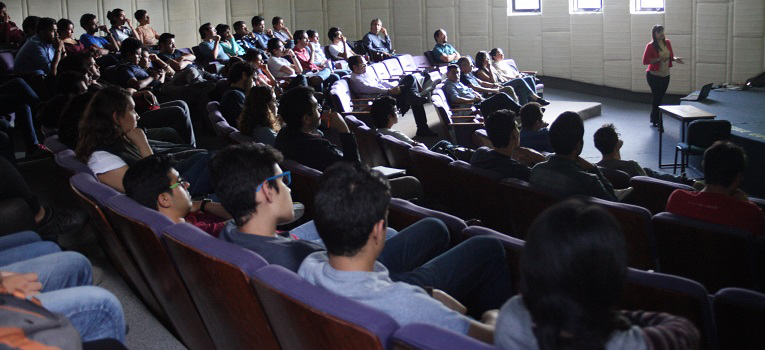
Guanajuato, Gto., November 1, 2018.- The contributions to science, the benefits to humanity and the trajectory of the Nobel laureates in physics, chemistry and medicine 2018 were the points that were addressed in the talk in which researchers participated in the Division of Sciences and Engineering of the León Campus of the University of Guanajuato (UG).
With the participation of Dr. Algeria Rosillo de la Torre, Dr. Silvia Alejandra López Juárez and Dr. Marco Laurati a talk was held to raise awareness of the main scientific findings of those who will receive on December 10 the Nobel prizes of Physics, Chemistry and Medicine in ceremony to be held in Stockholm, Sweden.
Dr. Silvia Alejandra López, researcher attached to the Department of Electronic and Biomedical chemical engineering was responsible for commenting on the Nobel Prize in the category of medicine or physiology that was announced by the Karolinska Institute. In this sense, she commented that James Allison and Tasuko Honjo were creditors to the award for their discovery of cancer therapy by inhibiting the negative regulation of the immune response.
She indicated that "the main contributions of these scientists are that they are allowing to develop a cancer immunotherapy that is already used for melanoma therapy and for the treatment of lung cancer and that in the future they may have other applications ".
In her speech he explained that James Allison studied a protein that works as a brake for the immune system and found that it was possible to release this function so that the immune cells could attack tumors. In the case of Tasuko Honjo, a Japanese scientist noted that he found which protein in the immune cells reacts similarly and revealed that it also works as a brake, but with a different mechanism of action.
For his part, Dr. Marco Laurati, deepened on the Nobel prize in physics, granted by the Royal Academy of Sciences of Sweden to the American Arthur Ashkin, the Canadian Donna Stricklan and the Frenchman Gérard Mourou for their "groundbreaking inventions in the field of physics of the laser." He commented that "the importance of these systems has applications in the industry for the manufacture of materials at a biological level to manipulate cells or other elements." The researcher from the physics Department of the Science and Engineering division stressed the importance of making known the course that science and the main contributions of the scientific community are taking.
In the case of Dr. Algeria Rosillo commented on the work of Frances H. Arnold, George P. Smith and Gregory P. Winter the three Nobel Prize winners of Chemistry. Laureates in this category have expressed that they have taken advantage of the power of the principles of evolution, genetic change, and selection to develop proteins that solve humanity's chemical problems. He added that the transcendence of "these works have social impact, since we have findings of how to make the chemical processes faster, more effective and above all more sustainable."