
Salamanca, Gto. October 23, 2018.- In Space week, students from the engineering division of the University of Guanajuato (UG) discovered the opportunities of the aerospace and aerospace industry, in the voice of experts invited to share their knowledge with the students of the Salamanca venue.
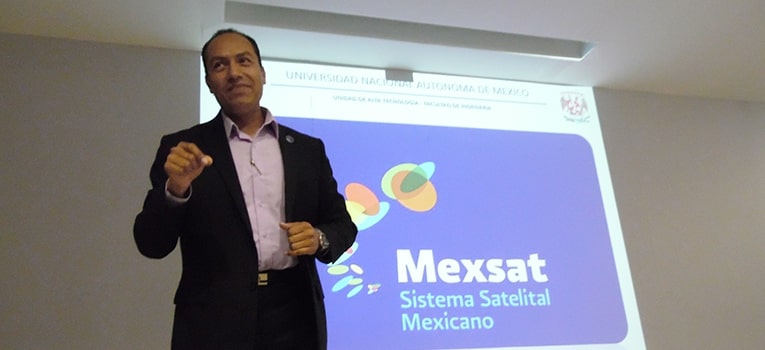
At the conference "33 years of the Morelos satellite system and its impact on the spatial development of Mexico", Dr. José Alberto Ramírez Aguilar, head of the Aerospace department at the High Technology Unit of the Universidad Nacional Autónoma de México (UNAM), he spoke of Mexico's past in space, with the first communications satellite for the country, Morelos 1, which was launched in Cape Canaveral on the NASA Space shuttle Discovery on June 17, 1985, and which was part of a series of Mexican communication satellites.
He also referred to the Mexican satellite system MEXSAT, which is integrated by the satellites Bicentennial and Morelos 3, and two control centers with advanced technological capacity, to offer telecommunication services with satellite technology.
The researcher and regional vice-President of the International Astronautical Federation showed a timeline from 1860 to date with all the aerospace activities carried out and those by UNAM, detailing the work carried out in UNAM's High-tech unit of the Faculty of Engineering related to satellites.
After referring to SATMEX 6, which with 5700 kilograms was launched in May 2006 from the space port Kourou of French Guiana, with a predicted lifespan of 15 years and 50% more power than the SATMEX 5, informed the audience that the week of space is held in October to remember the first Russian satellite called Sputnik that was launched in 1857 to orbit the Earth.
He told the students that it is a good time to enter the aerospace industry and motivated them to pursue their professional development in this field of knowledge.
In Space Week, other lectures were given as "Adding Epicycles: The cultural legacy of Claudio Ptolemy", by R. Moreno Ortíz; "Electronic circuits in the space race", by Dr. Gustavo Cerda Villafaña; and "Engineering applied to the structural thermo-fluid behavior of the human body", by Dr. Agustín Vidal Lesso.
Photo gallery