Guanajuato, Gto., December 22, 2018.- According to the consumption style that exists today, 1.6 worlds are required to maintain that level, if China were to be incorporated into this standard, two planets would soon be needed, and if India were to join hyper-consumerism, they would need three. For this reason, movements have emerged that pose more responsible practices that contemplate the care of the planet.
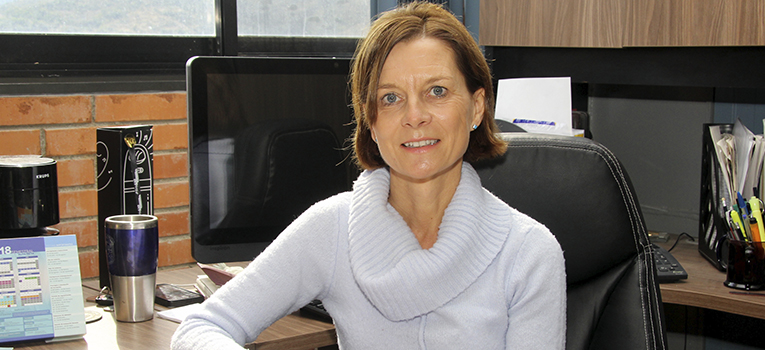
These new alternatives of sustainable consumption are the object of study of Dr. Eva Conraud Koellner, professor in the Division of Economic Management Sciences (DCEA) of the University of Guanajuato (UG), who considers that as an educational institution it has the mission and the opportunity to instill in the student community that it is possible to compete and generate profits in a much more sustainable way.
The researcher explained that advertising is a tool that promotes superfluous consumerism, "generates interest to buy things that we do not need and sometimes we do not even want; that's the consumer society." Over the course of the last 18 years we bought 60 percent more clothes than we used twice less, exemplified.
The problem is that consuming also implies producing waste, thus, according to the secretariat of Environment and Natural Resources (SEMARNAT), Mexico generates 9 billion of plastic bottles each year, of which 900,000 are not thrown into suitable spaces.
In her opinion, the big problem of our society is plastic. This material has given us great comfort, but at the same time it has caused serious damage to the environment. However, alternatives have emerged that seek to mitigate the impact on natural resources. Thus, there are solutions like plastics from agave or avocado waste.
"I believe that any business can rework this sustainable trade alternative," says the academic, who explained that this requires that from the moment a product is conceptualized, it is necessary to visualize it in all phases of its life cycle. Make sure that inputs, for example, do not affect the ecosystem, or that they have the capacity to be recycled.
She shared that, according to market research, 65% of people recognize that their consumption habits deteriorate little or much the environment and 95 percent think they should have more responsible consumption habits, but they don't.
Despite this data, Dr. Conraud maintains an optimistic view, because consumers have evolved, "Now the consumer is empowered by the purchasing decision. In the early days of marketing, companies were dedicated to selling, and are currently engaged in convincing consumers to buy. "
"The current consumer includes a vision of responsibility in their purchases. The millennial generation will soon occupy 30% of the economic power of society", hence the optimism of the academic of UG.
There is even another type, even more current, that uses digital tools with a vision of social responsibility. To this sector are directed some sustainable marketing tools that are the ones that Dr. Conraud promotes in her classes.
We are not asking that we sacrifice our welfare, because it has been detected that this is the reason why "the discourse of very radical environmentalists makes us uncomfortable as a consumer, because there is this phenomenon of happiness associated with consumption, so we must rework that so the satisfaction is based on the experience that contributes the product itself," she explained.
Therefore, it was celebrated that in the areas of studies more and more projects are being viewed with eco-innovation, where waste is used to remake new products. "I think it's a matter of working creativity, social and ecological innovation, and eliminating this binomial of production equals prosperity."
It is not about accumulating more things, I think we should visualize more a social, sustainable welfare, where our happiness does not depend only on consumption, she said.
That's what fair trade is all about, a way of doing business that integrates social justice, environmental protection, and transparency in the processes.
She explained that this phenomenon began since the years 50 and Mexico has been a precursor of production from fair trade but does not stand out as a consumer. In the state of Guanajuato there are some alternatives, in products like vegetables and canned goods and emphasizes the concept brand Guanajuato, that offers support to the small producers and at the same time guarantees a product of quality that does not damage the environment.
Photo gallery